
Solar ROI Calculator India & US: Find Your True Payback Period (2026)
Going solar is a big financial decision. You do not need a textbook definition of return on investment—you need to know when your system will begin paying you back.
The problem with most online calculators is that they use a static formula. They assume your utility rate will stay the same for the next 25 years. That is not how the energy grid works. To get a realistic picture of your financial future, you need to account for two things that actually determine your break-even point: government incentives and annual grid inflation.
Use the solar ROI calculator below to estimate your system’s payback period based on your inputs.
Advanced Solar ROI Calculator
Estimated Payback Period
The Solar ROI Calculator is intended for informational purposes only. The results provided are estimates and may vary based on factors such as panel quality, installation conditions, local weather, regional electricity rates, and government incentives. Always consult with certified solar installers or energy experts before making any financial or installation decisions.
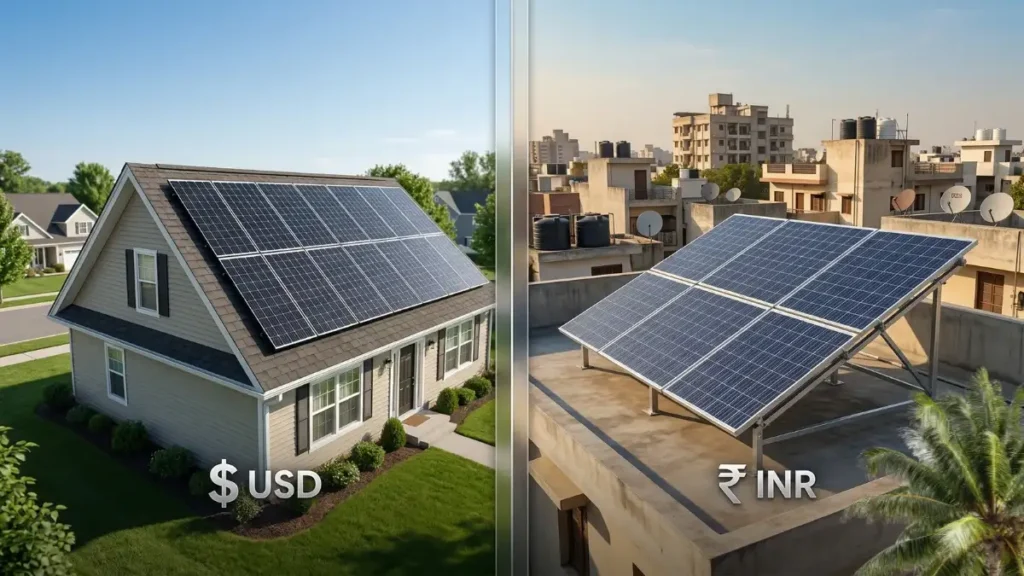
Why the Payback Period is Completely Different for USD vs INR
If you switch between the US and India settings in the calculator, you will notice a significant difference in payback timelines. India typically shows a break-even of 3 to 5 years, depending on state policies and usage patterns, whereas the US ranges between 6 and 9 years.
This is not a calculation error. It reflects a genuine difference in how solar is priced and subsidized in these two markets:
- Installation and Soft Costs: In the US, the panels themselves are only part of the bill. Most costs originate from “soft costs”—including labor, local permitting, and grid-connection fees. A standard US residential system averages around $2.80 per watt. To see how this scales, check our cost breakdown for 12–15 kW systems, which covers the regional price differences between the US and India. In India, cheaper labor and domestic manufacturing bring the gross cost down to roughly ₹60 per watt (about $0.72).
- Electricity Rates: US grid power is expensive, averaging $0.16 per kWh and much higher in states like California. High utility rates mean bigger monthly savings, which helps justify the upfront cost. In India, residential power is often state-subsidized at around ₹8 per kWh. You are replacing cheaper electricity, so the yearly savings in dollar terms are lower—but the lower upfront cost compensates for reduced savings, maintaining strong ROI.
- The Subsidy Structure: The US offers a 30% Federal ITC (Residential Clean Energy Credit), which is a tax credit—meaning you finance the full gross cost upfront and recover 30% at tax time. India uses direct capital subsidies like the PM Surya Ghar scheme, which cuts the cost right at the point of sale.
How to Calculate ROI on Solar Panels (The Real Formula)
Want to understand what’s happening behind the tool? Knowing how to calculate solar ROI manually is actually pretty simple. The core formula divides your total out-of-pocket cost by your annual energy savings.
To reflect reality, you need to use your net cost—not the sticker price. Here’s the framework:
- Determine Net System Cost: Start with your total quoted installation price and subtract any government incentives. This is also the stage where hardware choices—like opting for top solar battery storage systems—can affect your upfront investment while increasing your energy independence during blackouts.
- Calculate First-Year Savings: Multiply your total daily energy use (kWh) by your current utility rate.
- Factor in Energy Inflation: Historically, utility companies raise rates by 3% to 5% per year. Every time grid electricity gets more expensive, your solar system is saving you more money.
- Find the Payback Period: Divide your Net System Cost by your Year 1 savings.
Example: If your system costs $15,000 net, and you save $2,000 in year one, your payback period is 7.5 years. Since modern panels last 25 to 30 years, that leaves nearly two decades of essentially free electricity after you break even.
Hidden Variables That Alter Your Estimate
When using an ROI calculator for solar panels, your output is only as good as your inputs. Keep these three variables in mind before you sign anything:
- Available Sunlight: A 400W panel in Arizona will generate far more electricity than the same panel in Seattle. Make sure you’re entering the correct daily peak sun hours for your zip code or city.
- Panel Degradation: Solar panels lose a small amount of efficiency each year—usually around 0.5%. Choosing high-efficiency solar panels that use modern cell technology helps maximize your 25-year savings.
- Financing vs Cash: Paying cash for your system gives you the best ROI. If you take a solar loan, dealer fees and interest will push out your payback period. (This calculator assumes a cash purchase as your baseline.)
Frequently Asked Questions
A solid solar investment usually means a payback period of 5 to 8 years in the US, and 3 to 5 years in India. Once the system breaks even, the energy it produces is essentially free for the rest of its life.
No. This tool is built specifically for grid-tied systems where you’re offsetting an existing monthly electricity bill. Going fully off-grid requires heavy, expensive battery banks that significantly raise the upfront cost and stretch the ROI timeline. If you want backup power without a full rooftop commitment, exploring 2000Wh solar generator options is a more flexible way to manage your energy needs.
Yes. The calculator defaults to the standard 30% Federal Tax Credit for US users. You should manually adjust this field if your state offers additional rebates. For India, we default to an estimated 40% to reflect current central subsidies for standard residential rooftop systems (1–10 kW range), but you can adjust it based on your exact system size. One more thing—make sure your installation is done correctly. Avoiding common solar inverter installation mistakes helps protect your warranty and keeps you eligible for these incentives.