
Last Updated on May 7, 2026 by dhruwuttam58@gmail.com
If your home is consuming around 50 kWh of electricity a day, you’re probably wondering: how many solar panels for 50 kWh per day, and what size system do I actually need? You’re not alone. This is a common sizing question that homeowners ask once they start taking solar seriously. In most cases, you’ll require a 12–15 kW system, depending on location and system losses. But the exact number of panels depends on your roof space, local sunshine, and whether you want backup power or just lower bills. This estimate assumes ~4.5–5.5 peak sun hours and typical system losses of 10–20%.
Quick Answer: How Many Solar Panels for 50 kWh Per Day?
Short answer: A 50 kWh/day home typically needs a 12–15 kW solar system.
A home using 50 kWh of electricity per day typically needs a 12–15 kW solar system. This equals:
- 30–38 solar panels (400 W each)
- 22–28 solar panels (550 W each)
This estimate assumes around 4.5–5.5 peak sun hours and typical system losses of 10–20%.
👉 In sunny locations, you may need fewer panels, while lower sunlight or shading can increase system size.
This article may contain affiliate links. We only recommend products we believe offer real value. If you make a purchase, we may earn a small commission at no extra cost to you.
Table of Contents
Quick Answer: 50 kWh Solar System Overview
Here’s the at‑a‑glance summary before we unpack the details.
| Parameter | Typical Range |
|---|---|
| Solar System Size | 12 – 15 kW |
| 400 W Panels Needed | 30 – 38 panels |
| 550 W Panels Needed | 22 – 28 panels |
| Roof Space Required | 600 – 900 sq ft |
| Key Takeaway | A 12–15 kW system is ideal for most homes |
These ranges assume about 4.5–5.5 peak-sun hours and around 15% real‑world system losses from wiring, inverters, dust, and heat.
If you’re comparing panel kits, first check:
- Your average daily usage (in kWh)
- Available roof space
- Local peak sun hours
How Big Solar System for 50 kWh Per Day?
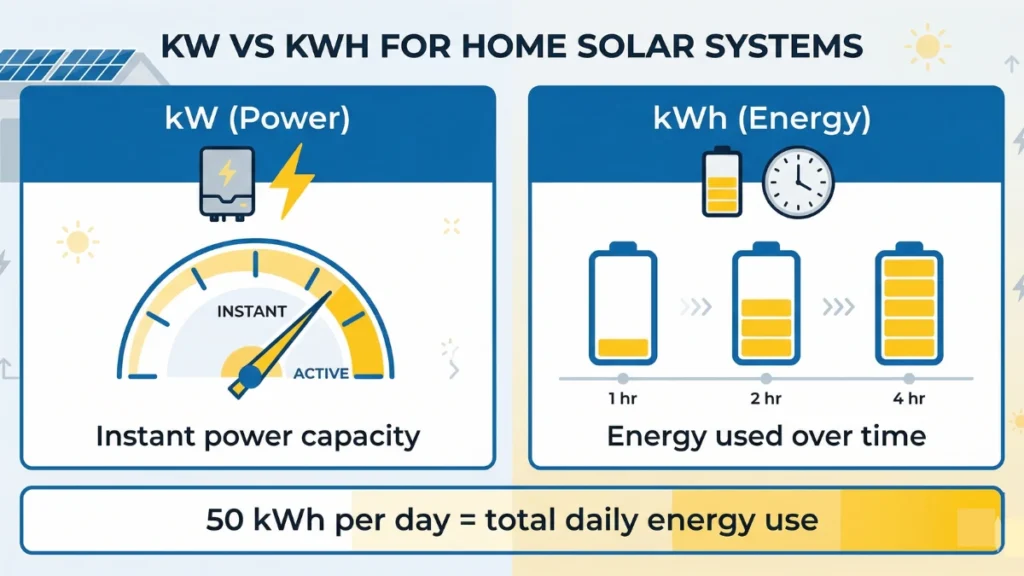
To figure out how many solar panels you need for 50 kWh per day, you first need to separate power (kW) from energy (kWh).
- kW (kilowatt) = system capacity, like the “engine size” of your solar.
- kWh (kilowatt‑hour) = energy used over time, which is what your bill charges for.
Here, 50 kWh/day is your daily energy use. Your goal is to size a solar array (in kW) that can generate about that much on an average day.
What does 50 kWh/day look like?
In the US, 50 kWh/day is a typical or slightly high usage for a detached home with:
- Central AC or multiple mini‑splits
- Electric water heater or heat pump
- Fridge, freezer, washer, dryer, dishwasher
- TVs, computers, EV charging, and plenty of lighting
In India, 50 kWh/day usually indicates a larger or higher‑consumption home (or home plus a small office) with multiple ACs, motors, and heavy appliances.
In both regions, that kind of load typically requires a rooftop solar system of roughly 12–15 kW, depending on your sun hours and shading.
How Many Solar Panels for 50 kWh Per Day (Step‑by‑Step)
This is a simple, homeowner‑friendly way to size your system.
Step 1: Estimate your peak sun hours
“Peak sun hours” (PSH) tells you how many hours per day your panels get full‑strength sunlight on average over the year.
Typical ranges:
- Many US locations: ~4–6 PSH
- Many Indian locations: ~4.5–5.5 PSH
For an easy starting point, use 5 peak sun hours if you’re in a reasonably sunny area.
Use this basic sizing formula:
System size (kW) = Daily energy (kWh) / [Peak sun hours * (1 – losses)]
Here, “losses” include inverter, wiring, dust, and heat.
If we assume:
- Daily energy = 50 kWh
- Peak sun hours = 5
- Losses = 15% (so you use 0.85 as the efficiency factor)
Then:
Required system size ≈ 50 ÷ (5 × 0.85) ≈ 11.8 kW
That’s effectively a 12–13 kW system once you allow for cloudy days and future load growth.
Step 2: Choose your panel wattage
Most 2026 residential roofs use panels in the 400–600 W range:
- 400 W panels: very common, flexible for tricky roofs
- 500–550 W panels: popular “sweet spot” for many homes
- 600 W+ panels: more common on big roofs or light commercial
To convert system size (kW) into panel count:
Number of panels = (System size in kW × 1000) ÷ Panel wattage (W)
This converts kW to watts and divides it by each panel’s rating.
For a 12–13 kW system:
- 400 W panels: 12,000–13,000 W / 400 W = 30–33 panels
- 550 W panels: 12,000–13,000 W / 550 W = 22–24 panels
If your area only averages around 4 peak sun hours, your system may need to be closer to 14–15 kW, which pushes the panel count higher.
If you’re comparing panel options, focus on panel wattage vs your roof space and layout, rather than just chasing the highest number on the spec sheet.
Step 3: Keep system losses simple (about 15%)
All real-world systems experience energy losses due to:
- Inverter inefficiency
- DC/AC cable losses
- Dust and bird droppings
- High rooftop temperatures
Independent benchmarks show 10–20% total losses are typical for residential systems, so using a simple 15% estimate usually keeps sizing realistic.
In fact, data from the U.S. National Renewable Energy Laboratory (NREL) shows that real-world residential solar systems typically experience 10–20% performance losses due to factors such as temperature, wiring, and inverter efficiency. Tools like NREL’s PVWatts calculator are widely used to estimate realistic solar output based on these factors.
For most homeowners, the practical move is: use 15% as a default, then let your installer fine‑tune it for your exact hardware and layout.
How Many 400 Watt Panels for 50 kWh?
If you’re specifically asking how many 400 watt panels for 50 kWh, you’re in the most common residential scenario.
With:
- Target output: 50 kWh/day
- Average: 5 peak sun hours
- Losses: ~15%
- System size needed: about 12 kW
You’ll typically need around 30–38 400 W panels, depending on location, tilt, and shading.
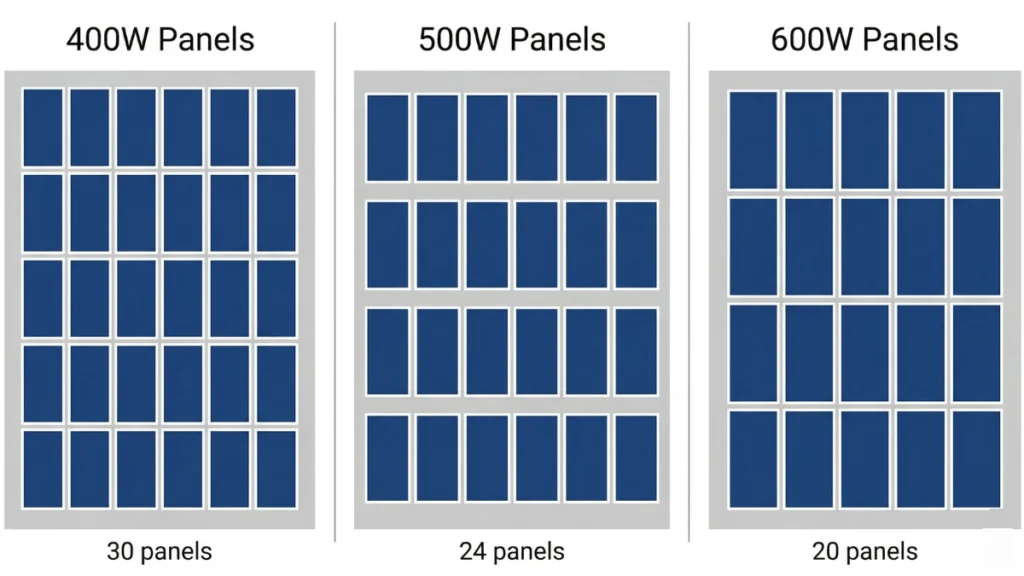
400 W vs 500 W vs 600 W
Here’s how panel count changes across popular wattages.
| Panel Wattage | Panels Needed (~12 kW) | Daily Output (Approx.) | Best For |
|---|---|---|---|
| 400 W | 30 panels | 50–55 kWh/day | Budget-friendly, flexible roof layouts |
| 500 W | 24 panels | 50–55 kWh/day | Balanced choice for most homes |
| 600 W | 20 panels | 50–55 kWh/day | Limited space, high efficiency setups |
The actual daily energy depends on your exact sun, tilt, and shading conditions.
Practical guidance
- If you have a normal‑sized, somewhat segmented roof, 500–550 W panels are a nice middle ground: fewer panels but still easy to fit.
- If roof space is tight, higher‑wattage panels (550–600 W) can help you hit 50 kWh/day with fewer modules.
- If your roof is large and simple, standard 400 W panels often offer good value and are easier to replace.
If your roof space is limited, it usually makes more sense to go with 550 W or higher panels to reduce the total number of modules. On the other hand, if budget is your main concern and space isn’t an issue, sticking with standard 400 W panels is often the most cost-effective option.
When you’re browsing panel kits online, compare not just the wattage, but also the panel dimensions and how they’ll actually fit on your roof.
If you’re also thinking about backup during outages, it’s worth considering a hybrid inverter with a battery bank alongside your solar panels. This setup typically offers improved resilience compared to a basic grid-tied system. If you want a deeper understanding of how backup systems work, you can explore our detailed guide to home solar generator backup.
Solar Battery Required for 50 kWh Per Day
Now, let’s look at the battery side of “solar battery required for 50 kWh per day.”
Do You Need Batteries?
A 50 kWh/day solar system does not automatically require batteries. In both the U.S. and India, most homeowners start with a grid-tied system without storage if the goal is to reduce electricity bills.
Batteries become important in two cases:
- You need backup power during outages
- You want to store excess solar energy for use at night or during peak tariff hours
Full Backup Sizing
If your goal is to run your entire home during an outage, you’ll need to size your battery system for full-day backup:
- You need about 50 kWh of usable storage.
- Most lithium batteries allow around 80–90% usable capacity (depth of discharge), depending on battery chemistry.
So:
Total battery capacity ≈ 62.5 kWh (50 kWh ÷ 0.8)
This gives you around 50 kWh of usable energy without over‑discharging the battery.
In practice, that might look like:
- About 6 × 10 kWh battery packs, or
- 3 × 20 kWh wall‑ or floor‑mounted units
This is a large and relatively expensive battery bank, similar to what small commercial sites might use.
If you’re getting quotes for full‑day whole‑house backup, compare battery warranties and cycle life closely, because this is where most of your system’s long‑term cost sits.
Partial Backup (Essentials-Only)
However, full-home backup is expensive and often unnecessary. Most homeowners choose to back up only essential loads:
- Lights and fans
- Router, computer, TV
- Fridge and maybe one small AC for limited hours
For this, a half‑day backup is often more realistic:
- Target usable storage: around 20–30 kWh
- Total battery capacity (at 80% DoD): roughly 25–37 kWh
That usually translates to:
- 2–3 batteries in the 10–15 kWh range each
For example, systems like EcoFlow DELTA Pro or Bluetti AC200L with B300K expandable batteries are commonly used for partial home backup, allowing you to scale storage based on your actual needs rather than overspending upfront.
This size works well for many US homes with storm‑related outages and Indian homes dealing with frequent load shedding.
If you only want to keep essentials running during outages, smaller systems like EcoFlow DELTA 2 Max or ALLPOWERS R1500 LITE can handle basic loads like lights, Wi-Fi, and refrigeration without requiring a full home setup.
For most homes, starting with a smaller battery (20–30 kWh for essential loads) is a more practical approach than going all-in on full backup from day one. You can always expand storage later as your needs or budget change.
If you’re unsure how much storage you need, start by listing which circuits or appliances truly need backup, then size batteries to cover just those for the number of hours you care about.
| Backup Type | Usable Energy Needed | Total Battery Capacity | Best For |
|---|---|---|---|
| Essential Backup (6–8 hrs) | 15–20 kWh | 18–25 kWh | Lights, fans, fridge, Wi-Fi |
| Half-Day Backup (10–12 hrs) | 20–30 kWh | 25–37 kWh | Most homes with moderate outages |
| Full-Day Backup (24 hrs) | 50 kWh | 60–65 kWh | Off-grid or full backup needs |
What Most Homeowners Actually Do
In real-world installations, most homeowners do not start with full-home battery backup.
A more practical approach is:
- Install a grid-tied or hybrid solar system first
- Add 20–30 kWh battery storage for essential loads
- Expand storage later if needed
This approach balances cost, reliability, and flexibility. It also avoids overinvesting upfront in battery capacity that may not be fully used.
For homes with frequent outages, even a modest battery setup can significantly improve day-to-day comfort without the cost of full backup.
Off‑grid vs hybrid
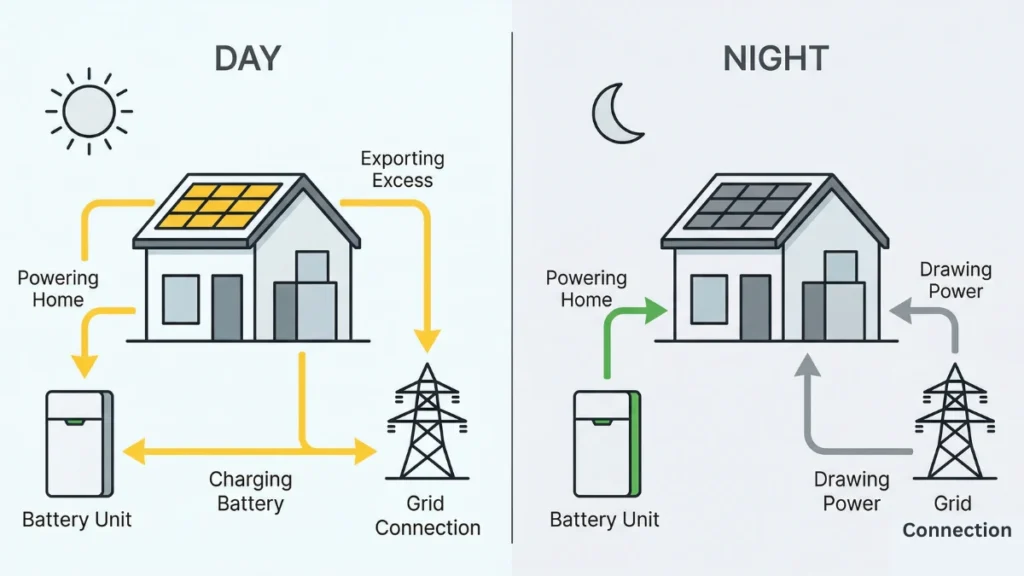
When pairing a 50 kWh/day system with batteries, you’ll generally choose between:
- Off‑grid:
- Designed for 1–3 days of autonomy plus oversized PV.
- For a 50 kWh/day home, this quickly becomes very expensive and complex.
- Hybrid (grid + solar + battery):
- The most practical option for most homeowners.
- Solar cuts your bill, the battery rides through outages, and the grid is still your safety net.
For larger or off-grid setups, advanced systems like EcoFlow DELTA Pro Ultra or Bluetti EP900 Energy Storage System are designed to handle heavier loads and longer backup durations, especially in high-consumption homes.
For flexible, portable backup (for example, to keep a fridge, modem, and medical devices running), a home-oriented portable solar generator can be a useful add‑on to your main rooftop panel system in outage‑prone areas.
If you’re comparing hybrid inverters and battery packs, prioritize reliability, warranty, and local service support over squeezing out the last few percent of efficiency.
What Does a 12–15 kW Solar System Cost?
Pricing varies significantly, depending on your region, local incentives, and the quality of your hardware. Here’s what to expect in two major markets:
United States: 12–15 kW system cost
Recent data (NREL) shows typical residential solar costs around 2.5–3.5 USD per watt before incentives, depending on equipment, installer, and state.
Approximate 2026 ranges:
- 12 kW system
- 12,000 W × 2.5–3.5 USD/W ≈ 30,000 – 42,000 USD before tax credits
- 15 kW system
- 15,000 W × 2.5–3.5 USD/W ≈ 37,500 – 52,500 USD before tax credits
The US federal Investment Tax Credit (ITC) can reduce net cost by roughly 30% for many homeowners.
According to the U.S. Department of Energy, federal incentives such as the Investment Tax Credit can significantly reduce the upfront cost of solar installations, making residential systems more accessible to homeowners.
Typical US payback for a well‑designed system is about 7–10 years, faster where electricity rates or incentives are higher.
If you’re comparing quotes, look not just at total price but also at cost per watt, included warranties, and whether monitoring is available in the app.
India: 12–15 kW rooftop cost
In India, residential rooftop projects often range from ₹55,000 to ₹75,000 per kW installed, depending on the city, hardware quality, and the installer.
Approximate cost:
- 12 kW system: about ₹6.6 – ₹9.0 lakh before subsidy
- 15 kW system: about ₹8.25 – ₹11.25 lakh before subsidy
Government programmes like PM Surya Ghar and MNRE rooftop solar schemes can subsidize eligible residential systems, though support levels and size caps vary by state and system capacity.
A well‑designed grid‑tied system in India usually has a payback of roughly 5–8 years, depending on local tariffs and subsidies.
To estimate your personal payback based on your bill and planned system size, use an online solar ROI calculator that lets you enter your own numbers.
And if you’re exploring backup-only solutions without installing a full rooftop system, it’s also worth checking out a practical guide on solar generators for home backup to compare more flexible options.
When you’re evaluating system cost, consider whether modest battery backup now (for essential loads) offers better comfort and resilience than going panels‑only and adding storage later at higher prices.
If your goal is maximum savings, it’s usually better to invest more in panels first and add batteries later. But if power cuts are frequent in your area, even a modest battery setup can make a big difference in day-to-day comfort.
Roof Space Needed for a 50 kWh Solar System
At this size, roof space often becomes the real constraint.
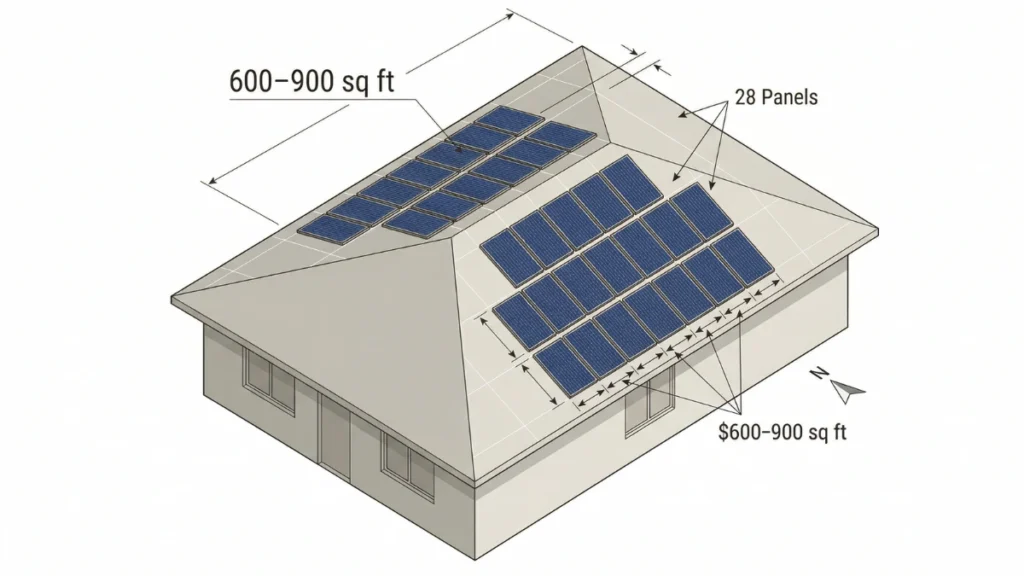
Most modern mono panels in the 400–550 W range are about 1.9–2.3 m² each, or roughly 20–25 sq ft per module.
Typical area per panel:
- 400 W panel: around 21–23 sq ft
- 550 W panel: around 24–26 sq ft
From earlier panel counts:
- 30–38 × 400 W panels: roughly 650–875 sq ft
- 22–28 × 550 W panels: roughly 530–730 sq ft
So, you’ll generally want around 600–900 sq ft (55–85 m²) of clean, unshaded roof for a 50 kWh/day system.
Simple layout tips
You can plan an effective layout by following a few core principles:
- Use the largest unshaded section of roof first (south‑facing in the Northern Hemisphere usually gives the best annual yield).
- Keep rows straight, and leave safe walkways for cleaning and maintenance.
- Avoid placing panels directly behind tall parapets, chimneys, trees, or water tanks that cast shadows.
- Plan a cool, ventilated spot for the inverter and batteries (garage, utility room, or shaded wall).
If your roof is tight on space, it’s usually better to invest in slightly higher‑watt panels and a smart layout than to force too many standard panels into shaded or awkward corners.
Common Mistakes When Sizing a 50 kWh/Day System
Here are some common pitfalls to avoid when deciding how many solar panels are needed for 50 kWh per day.
- Basing the design on one high bill
- Using only your highest-usage summer month can oversize the system.
- It’s better to work off a 6–12 month average plus realistic growth.
- Ignoring local peak sun hours
- Copying a friend’s system from another state or country can under‑ or overshoot.
- The US Southwest gets much more sun than the Northeast; India also varies by state.
- Underestimating shading and obstacles
- Even small shadows on a few panels can drag down an entire string.
- Ask your installer for a basic shading analysis or simulation.
- Mixing random panel types in one string
- Combining old and new panels, or different wattages, without careful design can cause mismatch losses.
- Sticking to one panel model per array is usually cleaner.
- Going fully off‑grid when a hybrid makes more sense
- For a 50 kWh/day home, going full off‑grid quickly gets expensive and complex.
- Grid‑tied or hybrid with modest batteries is usually the better deal in both the US and India.
- Choosing a very cheap inverter and batteries
- The inverter is your system’s brain, the battery is your energy “tank.”
- Low-tier equipment is more likely to result in excessive noise, lower conversion efficiency, and premature hardware failure.
- Skipping cleaning and maintenance planning
- Dust and droppings can easily cost 5–10% output.
- Make sure there is safe access for cleaning on shingles, tiles, or terraces.
Before you sign any contract, ask for a clear layout, estimated annual generation, and a simple explanation of how shading and tilt were handled.
For a more detailed look at inverter placement, wiring basics, and installation mistakes, you can also go through our solar inverter installation guide to avoid common setup errors.
FAQs
1. How many panels for 50 units per day?
For 50 units (50 kWh) per day, most locations require a 12–15 kW system, equivalent to 30–38 panels (400 W) or 22–28 panels (550 W), depending on sun hours and shading.
2. Is 50 kWh enough for a house?
Yes. In the US, 50 kWh/day is enough for most detached homes with AC and major appliances, while in India, it usually matches a larger or higher‑consumption home rather than an average flat
3. How big solar system for 50 kWh per day?
You’ll usually need a 12–15 kW rooftop solar system for 50 kWh/day, assuming about 4.5–5.5 peak sun hours and around 15% system losses; cloudier or more shaded sites may lean closer to 15 kW.
4. How many 400 watt panels for 50 kWh per day?
Most homes will need around 30–38 400 W panels to produce 50 kWh/day, with the exact number depending on your local sun, panel tilt, and shading
5. Do I need batteries for a 50 kWh/day solar system?
Batteries are optional if you want to cut your bill; a grid‑tied system without storage is very common. For outage protection, many homes use 20–30 kWh of battery storage for essentials, while 50+ kWh is needed for full‑house backup for one day.
Final Takeaway: How Many Solar Panels for 50 kWh Per Day?
For most homes, generating 50 kWh per day comes down to installing a 12–15 kW solar system, which typically means around 30–38 panels (400 W) or 22–28 higher-wattage panels, depending on your roof space and sunlight conditions.
The smarter approach is to match your system to your real-world needs—not just chase maximum output. If your roof is tight, go for higher-watt panels. If your budget is limited, start with a grid-tied system and add batteries later. And if outages are a concern, a hybrid setup with partial backup is usually the best balance.
At this level, solar isn’t just about saving money—it’s about energy independence and long-term reliability. If you’re planning a system this size, take a few minutes to estimate your actual savings and payback before making a decision.
About the Author

SolarGizmoGuide is an independent solar research and publishing platform focused on practical, real-world solar solutions for urban homes and apartments. Our editorial team analyzes solar gadgets, mounting systems, backup power systems, and portable solar technology to help readers make informed investment decisions.
All content is based on independent research, manufacturer technical documentation, and publicly available performance data. Articles are reviewed and updated periodically to reflect current installation standards, safety considerations, and evolving solar technology.