
Last Updated on February 25, 2026 by dhruwuttam58@gmail.com
Introduction: Why Portable Solar Power Matters for Outdoor Use
Whether you’re embarking on a multi-week camping expedition, living full-time in a van, or preparing for extended grid outages, reliable off-grid power has become a practical necessity. Portable solar systems eliminate the noise and emissions of traditional fuel-based generators while providing silent, renewable energy where conventional outlets don’t exist. Unlike diesel or petrol generators that require ongoing fuel supplies, portable solar systems use free sunlight—a resource available in most outdoor environments. The technology has matured significantly since the early 2010s; modern systems deliver realistic, measurable power output backed by durable battery chemistries designed for years of reliable service.
This guide explains how portable solar power actually works, what it can and cannot accomplish, and how to assess whether it suits your specific outdoor power needs. Rather than relying on optimistic marketing claims such as ‘5-hour full recharge’ scenarios, this article emphasizes conservative performance ranges and real-world limitations.
Table of Contents
What Is Portable Solar Power and How Do Portable Systems Work?
Portable solar power systems combine three or four core components that work together to capture sunlight, store energy, and deliver usable electricity.
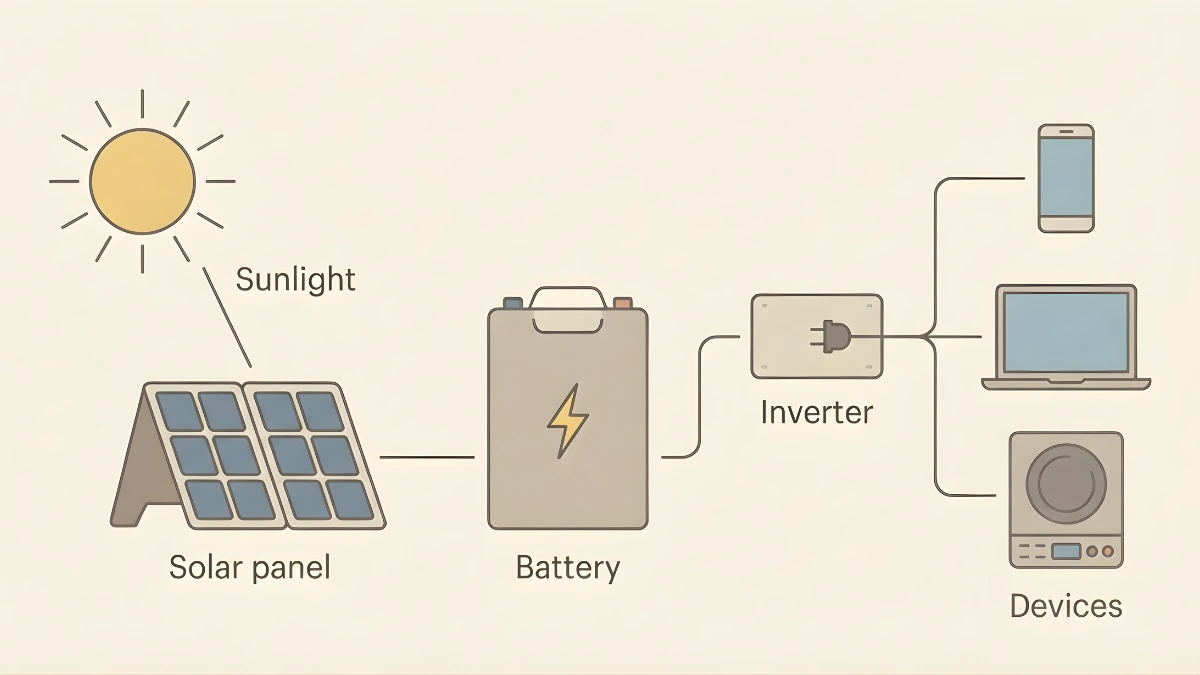
Solar panels are the intake device. Photovoltaic (PV) cells within the panel—typically made from crystalline silicon—absorb sunlight and convert it into direct current (DC) electricity. Unlike utility-scale solar farms, portable panels are designed to be moved and repositioned throughout the day to maximize sun exposure.
A battery storage unit, now almost universally built around lithium iron phosphate (LiFePO₄) chemistry, holds the electricity generated during sunny hours. The battery’s capacity—measured in watt-hours (Wh)—determines how long your devices can run without sunlight. A 500Wh battery, for example, can power a laptop (60W average draw) for roughly 8 hours under ideal conditions, accounting for system losses.
The charge controller regulates the power flowing from the panels into the battery. Without this component, inconsistent panel output—which varies with cloud cover, temperature, and sun angle—could damage the battery. Modern portable systems use an MPPT (Maximum Power Point Tracking) controller, which continuously adjusts to extract the maximum available power from the panels under changing conditions.
An inverter converts stored DC electricity into AC (alternating current) power—the standard format used by most household appliances and electronics. Without an inverter, you can charge USB devices directly, but you can’t power devices with standard wall plugs.
In consumer markets, there are two main configurations. Integrated systems, often called portable solar generators, combine the power station (battery, inverter, and charge controller) and solar panels into a matched kit, simplifying compatibility concerns. Modular systems allow you to purchase components separately, offering flexibility to scale capacity or upgrade individual parts, though they require more research to ensure compatibility.
Everyday Use Cases (Camping, RV Travel, Van Life, Emergencies, Outdoor Work)
Portable solar power addresses distinct energy scenarios, each with different capacity and reliability requirements.
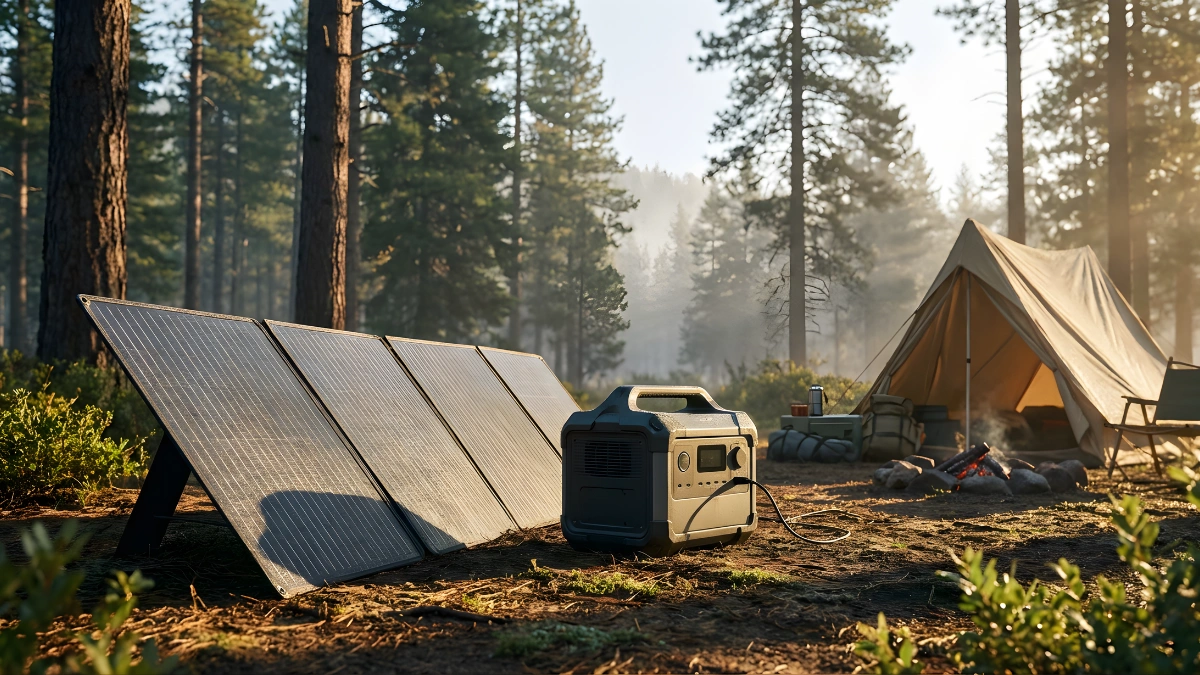
Camping and weekend trips represent the lowest-power scenario. A portable solar generator for camping is well-suited for charging phones, lights, and small appliances without noise. A 500Wh system with a basic 100W solar panel is sufficient for a 2-3-day trip in sunny conditions. Multi-week expeditions require larger battery banks and more panel area.
RV and van life users operate at a medium level of complexity. Full-time mobile dwellers need to sustain refrigeration, lighting, laptop work, and onboard systems indefinitely. This typically requires 3,000–10,000Wh of battery capacity, 1,500–5,000W of roof-mounted solar panels, and often a backup propane system or generator for cloudy weather stretches.
Many RV users rely on portable solar generators rather than fuel-based systems.
Emergency backup and off-grid preparedness typically involve a capacity of 1,000–3,000Wh. These systems serve as household power during grid outages, often paired with a larger battery bank for extended outages. Because outage duration is unpredictable, this use case emphasizes cycling ability and reliability over peak output.
Outdoor work and construction sites in remote areas often use portable solar to power tools, lighting, and communications equipment. High-power demands (angle grinders, compressors) exceed portable solar capacity, but modest site lighting and device charging are well within reach.
How Portable Solar Systems Actually Work
The energy conversion process happens in a predictable sequence, and understanding this flow clarifies why recharge times vary with weather and why oversizing capacity matters.
Step 1: Solar Generation:
On a clear day, a 100W solar panel under direct sunlight generates approximately 100 watts of power. That translates to 100 watt-hours in one hour of bright sunlight—but real-world conditions reduce this figure. The sun never shines from directly overhead (angle loss), atmospheric dust and water vapor reduce intensity (atmospheric loss), and panel temperature affects efficiency. A realistic expectation is 70–80% of rated capacity under ideal summer conditions, with significant declines in winter or cloudy weather.
Step 2: Charge Controller Regulation:
The raw DC electricity from the panels must be conditioned before storage. The charge controller samples the panel output many times per second, adjusting the voltage and current to match the battery’s needs. This prevents overcharging and optimizes energy transfer. MPPT controllers are more sophisticated; they actively track the maximum power point of the panels, improving efficiency by 15–25% compared to older PWM controllers.
Step 3: Battery Storage:
Electricity flows into the battery’s cells, where it’s stored as chemical potential energy. LiFePO₄ batteries accept this charge efficiently (95–98% charge efficiency), meaning minimal energy is lost as heat during the process. The battery will continue accepting charge until it reaches full capacity, at which point the charge controller stops the flow to prevent damage.
Step 4: Power Discharge and Conversion:
When you plug in a device, the battery supplies DC to the inverter. The inverter converts this DC power to 120V or 240V AC electricity (depending on your region and inverter specification). This conversion process is typically 85–90% efficient in consumer-grade portable systems, depending on inverter design and operating conditions.
Step 5: Load Consumption:
Your device consumes the AC power for its operation. Simultaneously, if sunlight is available, the solar panels continue generating power, which the charge controller directs into the battery, offsetting the discharge and extending runtime.
This process demonstrates why advertised battery capacity does not translate directly into usable energy. A 1,000Wh battery powering a 100W device might suggest 10 hours of runtime, but system losses (inverter efficiency, charge controller standby draw, and battery management) typically consume 10–15% of stored energy. Realistic runtime would be approximately 8.5–9 hours.
Battery Technology in Portable Solar Systems (LiFePO₄ Focus, Lifecycle Explained)
Lithium iron phosphate (LiFePO₄) has emerged as the dominant and mature battery technology for consumer portable power systems as of 2026.
Efficiency and Performance:
LiFePO₄ batteries achieve 90–98% round-trip efficiency—meaning 90–98% of the energy stored can be extracted for use. This significantly outperforms lead-acid batteries (80–85% efficiency) and older lithium-ion chemistries. The charge efficiency alone reaches 95–98%, so minimal energy is wasted during storage. This efficiency advantage compounds over years of use, making LiFePO₄ systems more practical for off-grid living where every watt matters.
Depth of Discharge (DoD):
LiFePO₄ batteries tolerate deep discharge cycles—using 80–100% of stored capacity—without shortening their lifespan. Lead-acid batteries, by contrast, lose longevity if regularly discharged beyond 50%. This characteristic means LiFePO₄ systems deliver usable capacity that matches their nameplate rating.
Cycle Life and Durability:
A typical consumer-grade LiFePO₄ portable power station is rated for 2,000–6,000 charge cycles depending on the model and build quality. Each cycle represents one full charge followed by one discharge. At this rate, a system cycled daily would operate for 5–16 years before capacity degradation became noticeable. Premium models exceed 6,000 cycles; budget options may fall below 3,000. This durability makes the higher upfront cost more economically defensible over a long ownership period. [Source: EPEVER]
Temperature Performance:
LiFePO₄ batteries maintain consistent performance across a wide temperature range: typically -20°C to 60°C (-4°F to 140°F). Cold temperatures reduce capacity by approximately 20% at 0°C compared to 20°C, but the battery recovers that capacity when warmed. This characteristic—superior to traditional lithium-ion in frigid conditions—matters for winter campers and high-altitude users. Icy conditions (below -20°C) may prevent charging as a safety measure to avoid lithium plating, but discharge still functions.
Safety Architecture:
LiFePO₄ chemistry is inherently more thermally stable than traditional lithium-ion cells. The battery management system (BMS) integrated into every modern portable power station monitors cell voltage, temperature, and current in real-time. It disconnects the pack if unsafe conditions arise (overcharge, over-discharge, overheating, or overcurrent). This multi-layer safety approach—both chemical and electronic—significantly reduces fire risk compared to older battery types, though any lithium battery can pose hazards if damaged or misused.
Practical Expectation:
A well-maintained LiFePO₄ portable power station should retain 80–90% of its original capacity after 10 years of typical camping or RV use (1–2 cycles per week). Professional-grade systems with better BMS and cell matching often exceed this. Budget systems (under $300) may degrade faster, particularly in extreme climates.
Solar Panel Types and Real-World Efficiency (Foldable vs. Rigid, Weather Limitations)
The type of solar panel you choose fundamentally affects both the physical footprint and the actual energy output of your system. The distinction between foldable and rigid panels reflects a trade-off between portability and sustained performance.
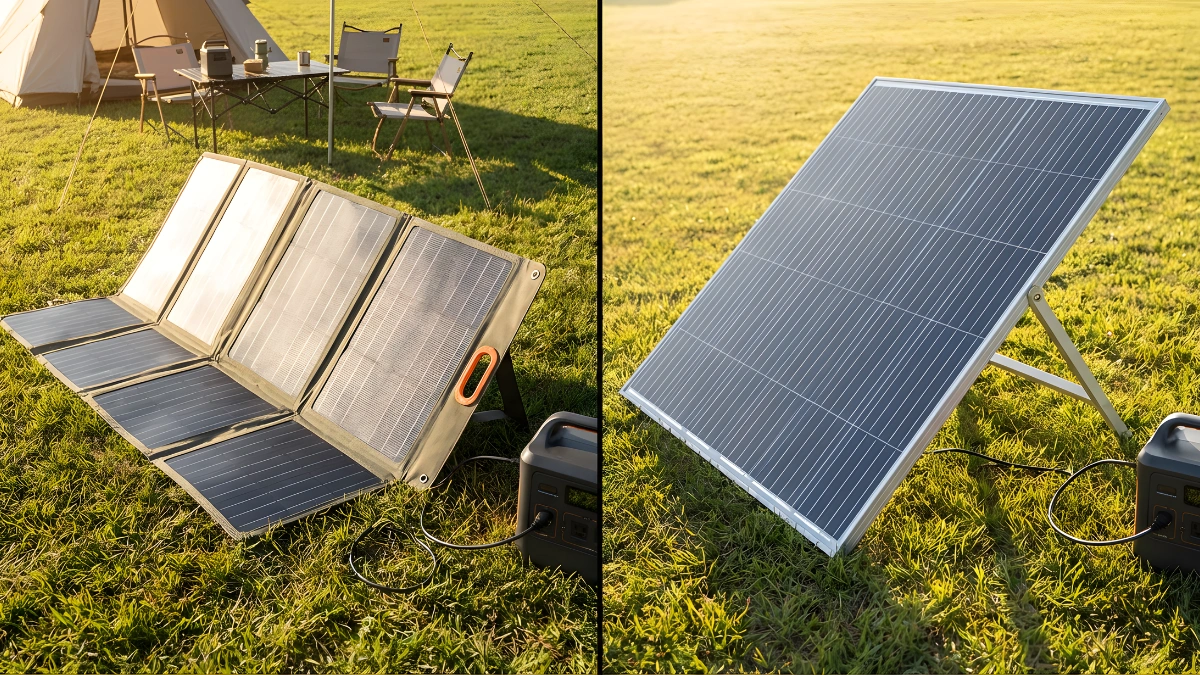
Foldable Portable Panels:
Typically use monocrystalline silicon cells laminated into flexible or semi-flexible substrates, allowing them to fold for transport while sacrificing some durability and thermal stability compared to rigid panels. A foldable 100W panel might weigh 2–3 kg and compress to a backpack-sized footprint, making it ideal for hikers and minimalist travelers.
The efficiency trade-off is significant. Most foldable panels typically achieve 15–18% conversion efficiency; some premium models reach 22%. The lower efficiency means a foldable panel requires more surface area to match a rigid panel’s output. Independent side-by-side testing consistently shows that foldable panels produce 15–30% less energy than rigid panels of the same rated wattage under identical conditions. [Source: Wikipedia]
Durability also suffers. The plastic backing and flexible encapsulation degrade under prolonged UV exposure; many users report the surface turning milky within 3–5 years of regular outdoor use, progressively blocking light. For car camping and RV use where panels remain deployed most of the time, rigid panels offer superior longevity.
Rigid Panels:
Constructed from monocrystalline silicon cells encased in tempered glass and aluminum frames, rigid panels represent the industry standard for home solar arrays and are increasingly used for RV installations. Modern monocrystalline panels achieve 22%+ conversion efficiency, with premium models approaching 23–24%.
These panels weather decades of outdoor exposure. The tempered glass face withstands hail and impact; the aluminum frame resists corrosion; the internal construction resists moisture ingress. A well-mounted rigid panel routinely delivers stable power for 25–30+ years, though output gradually declines by approximately 0.5% per year due to inherent cell degradation.
Rigid panels run hotter than foldable panels under intense sunlight, slightly reducing efficiency in summer. However, their superior temperature coefficient—a measure of how efficiency changes with temperature—means they maintain better relative performance across seasonal variations.
Weather and Environmental Factors:
All solar panels require direct or diffuse sunlight to generate power, and cloud cover can dramatically reduce output. Under bright overcast conditions (diffuse light only), a 400W panel array—or a 200W portable solar panel setup scaled appropriately—typically produces only 160–240W of actual power, a 55–60% reduction. In thick overcast skies, this drops to 40–100W, or 10–25% of rated capacity.
Snow and ice completely block the flow; even a thin frost layer significantly reduces output. Winter performance further declines because the sun sits lower on the horizon, delivering energy at a shallower angle. The combination of shorter days, lower sun angle, and cloud cover typically reduces winter solar generation by 40–80% compared to summer, a critical consideration for year-round off-grid systems.
Power Needs for Outdoor Use (Phones, Lights, Fridge, CPAP—Realistic Expectations)
Sizing a portable solar system begins with understanding how much power your devices actually consume. Manufacturers specify peak power (the maximum draw at startup) and continuous power (sustained operation). Portable solar systems must handle surge power, but are typically limited by constant output.
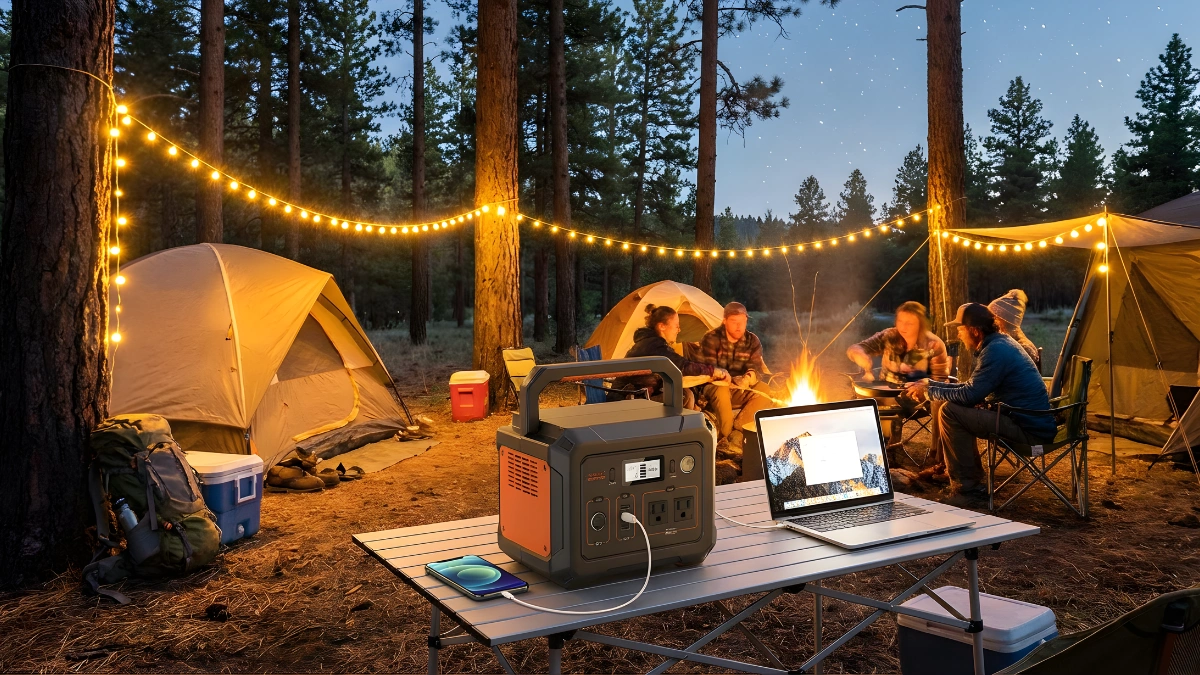
Small Electronics and Charging:
- Smartphone charging: 5–20W sustained (30 minutes to charge fully)
- Laptop charging: 50–100W sustained (2–4 hours to charge fully)
- Portable power bank: 10–30W (1–2 hours)
- LED camping light: 5–15W (8–12 hours runtime)
- Portable fan: 10–30W (4–8 hours runtime)
A 500Wh battery can charge a smartphone 10+ times over, or run a laptop for approximately 5–8 hours at moderate load.
Medical Equipment and Continuous Loads:
CPAP machines represent a practical test case for overnight reliability. Modern CPAP machines consume 30–60W without a heated humidifier, or 55–95W with one enabled. A full night of sleep (8 hours) requires 240–480Wh (without a humidifier) or 440–760Wh (with a humidifier). A 500Wh system can support one night of CPAP without a humidifier, but two nights require 1,000Wh+ capacity. Users who need humidifiers practically need 1,000Wh or more.
Manufacturer testing data generally confirms these ranges. A 632Wh system can sustain CPAP without a humidifier for approximately 1.1-2.3 nights; adding a humidifier cuts this to 0.7–1.2 nights per charge.
Refrigeration and Cooking:
Mini-fridges and portable coolers draw 50–80W continuously, consuming approximately 1,200–1,920Wh per 24-hour period. A dedicated 2,000Wh battery—available in many high-capacity solar generator options—cycled daily could theoretically power a mini-fridge. Still, real-world efficiency losses and competing device loads make this marginal. Most users pair small coolers with solar power rather than relying solely on refrigeration.
High-power appliances expose portable solar fundamental limitations:
- Microwave ovens: 800–1,500W sustained (5–10 minutes bursts drain 70–250Wh per use)
- Induction cooktops: 1,000–1,500W sustained (20–40 minutes requires 330–1,000Wh)
- Standard refrigerators: 800–1,200W peak, approximately 3,000–5,000Wh daily
- Air conditioning: 2,000–5,000W (not portable-solar feasible)
A 2,000Wh system running an induction cooktop at high power would deplete a significant portion of its capacity within minutes. Preparing full meals often requires multiple charging cycles between cooking sessions or accepting reduced cooking duration.
Realistic Multi-Device Scenario:
A typical camping weekend might involve: phone charging (100Wh), laptop work (300Wh), LED lighting (100Wh), and fan operation (150Wh)—totaling 650Wh daily. A 1,000Wh system with a 200W solar array would recharge during the day and sustain this load into the evening, with a comfortable margin.
Recharge Scenarios (Sunny vs. Cloudy vs. Winter Conditions—Conservative Ranges)
Recharge duration is perhaps the most frequently misunderstood aspect of portable solar systems. Real-world recharge times are significantly longer and highly variable.
Optimal Summer Conditions (Clear Sky, 10 AM–2 PM):
A 400W solar panel array under full summer sun generates approximately 80% of its rated capacity (320W actual output), accounting for angle losses, atmospheric absorption, and cell temperature effects. A 600Wh battery would fully recharge in approximately 1.9 hours (600Wh ÷ 320W).
In practice, even ideal summer days offer only 4–6 hours of genuinely productive sunlight (when the sun is above 45° elevation). A 1,000Wh battery would require roughly 3–4 hours of peak sun, or effectively a full 6–8 hours of variable sunlight.
Bright Overcast Conditions:
Cloud cover that provides bright ambient light but no direct sunlight reduces effective panel output to 160–240W for a 400W array. A 600Wh battery would recharge in 2.5–3.8 hours under these conditions. Importantly, this represents “bright overcast,” where you can see transparent shadows. Complete cloud cover is worse.
Thick Overcast or Gray Days:
Solar panels continue to generate electricity on cloudy days, but output can drop significantly depending on cloud thickness and sunlight diffusion. [Source: SunRun]
In thick cloud cover, the same 400W array produces only 40–100W. Recharging 600Wh would take 6–15 hours—effectively spanning a full day. For users in maritime climates, the Pacific Northwest, or UK-equivalent conditions, this is the norm for extended periods.
Winter Conditions (Latitude 45°N or Higher):
Winter presents compounded challenges. Even on clear winter days, usable sunlight hours are fewer. Snow cover blocks generation entirely; a thin frost layer reduces output by 50%+. Realistic winter recharge time for a 1,000Wh battery on a clear winter day: 6–8 hours. In cloudy winter weather: 1–2 days. This explains why off-grid winter living requires either 2–3 times the battery capacity or a backup generator.
Practical Daily Cycle:
Users planning multi-week trips should assume a conservative model: 600–700W of solar input (not peak capacity) on average across variable weather, allowing a full recharge of 1,000–1,500Wh in 1.5–2.5 days under typical conditions. In regions with frequent cloud cover or winter use, double these estimates.
Safety Considerations for Outdoor Solar Power
Portable solar systems are generally safe when used as designed, but several hazards warrant explicit attention.
Battery Fire Risk:
Lithium batteries can ignite if the internal cells are damaged, overcharged beyond safe voltage limits, or exposed to thermal runaway conditions. Cause-and-effect: physical damage (crushing, puncturing), exposure to saltwater or corrosive substances, or overloading the inverter can degrade cell integrity. Prevention is straightforward: operate the unit within its specified wattage limits, avoid immersion in water, store it in a dry location away from flammable materials, and inspect it regularly for physical damage.
Water and Moisture Exposure:
Saltwater and humid environments accelerate corrosion of connectors and internal circuits. Wet conditions create electrical shock hazards, particularly around the inverter and AC outlets. Portable power stations designed for RV use include weatherproofing, but prolonged exposure to rain or submersion exceeds manufacturer specifications. Keep the unit dry and ventilated; avoid using outdoor outlets in wet conditions.
Overloading and Inverter Shutdown:
Exceeding the inverter’s continuous power rating causes the system to shut down as a protective measure. This is not a hazard but an inconvenience—attempting to run two microwaves or an induction cooktop, alongside other high-demand devices, may trigger a shutdown. Consult the inverter’s surge capacity rating; it will handle temporary overloads (such as motor startup) but not sustained overloads.
Panel Handling:
Solar panels are fragile. Impact or excessive force can crack internal silicon cells, causing internal short circuits or reducing output. Handle panels carefully during deployment and storage; secure them against wind loading and falling debris.
Wiring and Connector Integrity:
Loose connections increase resistance, causing heat buildup and potential fire. Inspect wiring regularly for damage, ensure all connectors are fully seated, and use strain relief at connection points. For systems you assemble yourself (modular setups), use the appropriate wire gauge for the current in each circuit; undersized wire can cause dangerous heat.
Cold Weather Charging:
Some systems turn off charging at temperatures below 0°C to prevent lithium plating (a degradation mode in which lithium deposits on the anode). If you need to charge below this threshold, warm the unit in an insulated bag or vehicle cabin first.
Limitations of Portable Solar Power (What It Cannot Do)
Understanding the boundaries of portable solar technology is essential to avoiding disappointment and unsafe operating decisions.
Continuous High-Power Appliances:
Induction cooktops, electric ovens, air conditioning, and central heating consume 1,500+ watts continuously or draw ample surge power. A 2,000Wh battery powering an induction cooktop at maximum rated output (1,500W) would deplete a significant portion of its capacity within minutes. While intermittent use (cooking a meal over 30 minutes with the device running at partial power and resting between courses) is possible, continuous high-power operation is not. Propane, butane, or a traditional generator are the practical choices for full-time cooking in off-grid environments.
All rechargeable batteries gradually lose capacity over time due to charge cycles, environmental conditions, and usage patterns. [Source: Wikipedia]
Central Air Conditioning and Heat:
Cooling demand in summer RVs or backup power during heatwaves exceeds the capacity of portable solar. A 2.5-ton AC unit draws 3,000–5,000W. Even a 10,000Wh battery would last less than 2 hours. Full-time off-grid air conditioning requires whole-home battery systems ($25,000+) and 10+ kW of solar panels.
Unlimited Runtime:
Portable systems cannot operate indefinitely without recharge. This is why long-term off-grid living requires either accepting reduced power consumption, massive battery banks, or backup generation for cloudy weather stretches. If you consume 1,500Wh daily and experience three consecutive cloudy days, a 2,000Wh battery alone is insufficient.
Full Household Power:
A portable system cannot replace grid electricity for an entire home. Typical household consumption ranges from 20–50kWh daily; a portable system providing 2–10kWh daily serves a supplemental or backup role, not as primary power.
Guaranteed 24/7 Reliability:
The weather is unpredictable. A week of heavy cloud cover or a winter storm can deplete batteries faster than solar recharges them. Systems designed for true off-grid reliability include weather forecasting (to plan power consumption), battery oversizing (to weather 3–7 cloudy days), or generator backup.
Saltwater and Extreme Corrosion:
While weatherproof, portable systems are not designed for marine environments, where saltwater spray can corrode connectors and electronics. Coastal users require specialized corrosion-resistant enclosures.
Cost Ranges and Value Expectations (No Pricing Promises)
Portable solar system pricing reflects capacity, build quality, and brand positioning. Prices fluctuate based on manufacturing costs, supply chain factors, and regional markets, so these ranges provide direction rather than guarantees.
Portable Power Stations (Battery + Inverter + Controller Only, No Panels):
- 200–300Wh compact units: $80–150 (emergency backup, phones)
- 500–600Wh units: $300–600 (weekend camping)
- 1,000Wh units: $500–1,200 (moderate RV/backup use)
- 2,000–3,000Wh units: $1,200–2,500 (serious off-grid)
- 5,000+Wh premium units: $2,500–5,000+ (full-time RV, whole-home backup)
Entry-level brands offer units at the lower end of these ranges; established brands like Jackery, EcoFlow, and Bluetti command 20–40% price premiums, justified by more extended warranty periods, higher cycle ratings, and better customer support.
Portable Solar Panels (Hardware Only, No Battery):
- 100W foldable: $150–300
- 200W foldable: $300–600
- 100W rigid (small): $150–250
- 400W rigid array: $800–1,500
- 600W+ array: $1,500–3,000+
Foldable panels cost more per watt than rigid panels because the engineering for portability increases manufacturing complexity. However, the weight savings justify the premium for travel-focused use.
Integrated Kits (Power Station + Matching Panels):
- Small kits (300Wh + 100W panels): $400–800
- Medium kits (1,000Wh + 200W panels): $1,000–1,800
- Large kits (2,000Wh + 400W panels): $2,000–3,500
- Premium kits (3,000+Wh + 600+ W panels): $3,500–7,000+
Integrated kits offer better overall value than mixing brands; the manufacturer pre-matches components for compatibility.
Modular System (Advanced RV/Van Build):
Assembling a serious off-grid system from separate components—battery bank, MPPT charge controller, inverter, mounting hardware—typically costs:
- 5,000Wh modular system: $2,500–4,000
- 10,000Wh modular system: $4,500–8,000
- 15,000+Wh system: $7,000–15,000+
These modular systems offer greater scalability and often include professional-grade components (Victron and Epever controllers) with longer lifespans and superior performance.
Long-Term Cost Perspective:
The initial cost is the primary consideration, but lifecycle costs matter as well. A $600 portable power station lasting 10 years (at 200 cycles annually = 2,000 cycles) costs $0.30 per cycle. A $2,500 RV-grade system lasting 15+ years costs $0.10–0.15 per cycle. For daily users, the per-cycle efficiency of premium systems justifies a higher upfront investment.
Energy industry reports indicate that lithium-ion battery costs have steadily declined over recent years due to manufacturing scale and technological improvements. [Source: U.S. Department of Energy]
How Portable Solar Fits into Emergency Preparedness
Portable solar systems serve distinct preparedness roles depending on your household situation and outage expectations.
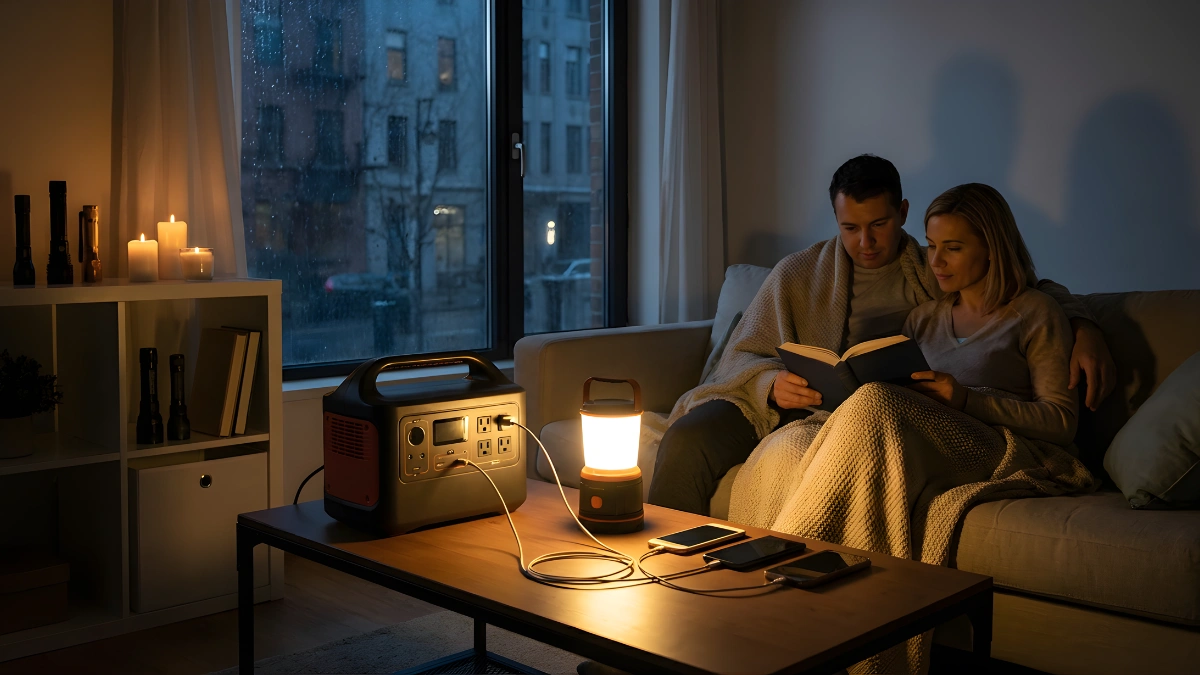
Short-Term Outages (1–3 Days):
A 1,000–2,000Wh battery with solar panels ensures essential devices remain charged: phones, medical equipment, refrigeration, lighting, and communications. This is achievable with a consumer-grade system costing $500–1,500.
For short-term outages, portable solar generators—often combined into a solar power survival kit—provide silent, indoor-safe backup.
Extended Outages (3–14 Days):
Sustained power requires either accepting severe load reductions or investing in larger systems that overlap with solar generator solutions for home backup (5,000–10,000Wh). Solar panels can recharge during the day, extending battery life, but cloudy weather conditions significantly reduce this benefit.
Off-Grid Living (Indefinite):
Experienced RV and van-life users report that long-term off-grid sustainability depends heavily on battery capacity, which is why many recommend sizing systems 1.5–2× above average daily needs, allowing the battery to weather multi-day cloudy periods without dropping below 20% state of charge (which stresses the battery). This is why RVers operating entirely off-grid typically deploy 3,000–10,000Wh batteries paired with 2–5kW of solar panels, plus often a propane backup or generator.
Hybrid Approach (Common in RV/Van Communities):
Rather than relying solely on solar, most off-grid users operate a hybrid system: solar provides primary charging during good weather, a battery bank buffers daily consumption, and a propane generator or backup AC charger tops up the battery during cloudy stretches. This balance maximizes fuel efficiency (the generator runs fewer hours) while ensuring reliability.
Cost Comparison: Generator vs. Solar:
A fuel-based standby generator costs $7,000–15,000 for whole-house capacity but incurs $500–1,500 in annual fuel, maintenance, and eventual replacement costs (10–15-year lifespan). A comparable solar-plus-battery system costs $15,000–30,000 upfront but has minimal operating costs, aside from occasional panel cleaning and inverter maintenance. Over 20 years, the solar system is economically superior, but the generator wins on upfront cost and guaranteed power output regardless of weather.
Public safety agencies warn that fuel-powered generators emit carbon monoxide, which can be extremely dangerous if used in enclosed or poorly ventilated areas. [Source: CPSC]
Future Trends (Only Near-Term, Realistic Developments)
Portable solar technology is advancing, but meaningful consumer-facing changes are incremental rather than revolutionary. This section covers only developments in the 2024–2027 timeframe with clear commercialization pathways.
GaN-Based Chargers and Inverters:
GaN-based components are appearing in select premium portable power stations, enabling higher efficiency and smaller form factors, though most consumer systems still rely on silicon-based designs. GaN enables higher power conversion efficiency (>90% vs. 85–88% silicon) in a smaller, lighter package that dissipates less heat. This allows manufacturers to build more compact power stations without thermal throttling. Cost premiums are declining as manufacturing scales.
Bifacial Solar Panel Development:
Bifacial panels—which harvest sunlight from both front and rear surfaces via reflected ground radiation—can theoretically increase output by 20–30% in ideal conditions (snow-covered ground, white concrete beneath panels). Perovskite bifacial cells in laboratory settings have achieved 98% bifaciality factors with 36+ mW/cm² power density. However, consumer bifacial portable panels remain nascent; realistic availability in durable, weatherproofed portable form is 2–3 years away.
Perovskite Solar Cells:
Perovskite semiconductors have achieved laboratory efficiency records exceeding 26%, compared with 23% for commercial crystalline silicon. Manufacturing costs are projected to be lower than silicon. However, stability and weatherproofing challenges remain unresolved at the consumer scale. Commercial deployment in portable panels is unlikely before 2027–2028.
Integrated Smart Management:
Real-time cloud-based monitoring (solar generation vs. consumption forecasting, weather-based charging optimization, load management) is becoming standard in mid-range and premium systems. This enables remote power optimization and predictive alerts when weather trends call for load reduction. Current systems offer this; widespread adoption improves user experience but doesn’t fundamentally change capacity or efficiency.
Solid-State Battery Research:
Solid-state batteries—replacing liquid electrolyte with solid materials—promise higher energy density and improved safety. These remain in the development phase; commercial consumer products are not expected before 2027–2030 at the earliest.
Conclusion: Choosing Practical Portable Solar Power in 2026
Portable solar power has transitioned from niche camping gear to a proven, practical energy solution—part of the broader ecosystem of modern solar gadgets for everyday use—for outdoor use, emergency backup, and off-grid living. Modern systems—particularly those built around LiFePO₄ batteries and MPPT charge controllers—deliver reliable performance over years of regular use.
The key to satisfaction is matching expectations to reality. A 500Wh system powers phones and lights reliably; a 1,000Wh system supports laptop work and CPAP machines one night; a 5,000+Wh system with 2–3kW of panels approaches actual off-grid capacity.
The technology works best as part of a diversified energy strategy. For outdoor use, a portable solar generator for camping offers a clean and dependable alternative to fuel-based power. For RV living, it reduces generator runtime (and fuel costs) while preserving quiet camping experiences. For emergency preparedness, it ensures critical devices remain charged during grid outages.
Emerging technologies (bifacial panels, perovskite cells, solid-state batteries) are interesting but not necessary for practical systems. Consumers benefit more from oversizing existing technology than waiting for theoretical improvements.
Portable solar power succeeds because it’s simple, silent, and increasingly affordable. It fails only when expected to do things outside its physical limits—continuously powering air conditioning, or providing energy for weeks without recharge.
FAQs
Is portable solar power reliable for camping and travel?
Yes, portable solar power is reliable for camping and travel when the system capacity matches real energy needs. Phones, lighting, laptops, and small appliances are well supported, while high-power devices like air conditioners remain impractical.
How long does a portable solar generator last?
Most modern portable solar generators using LiFePO₄ batteries are rated for 2,000–6,000 charge cycles. With typical camping or RV use, this translates to 8–15 years before noticeable capacity reduction.
Can a portable solar generator run a refrigerator or CPAP machine?
Yes, an adequately sized portable solar generator can run a CPAP machine overnight and support small refrigerators. Continuous refrigeration usually requires 1,500–2,000Wh of battery capacity, plus daytime solar recharging.
Does portable solar power work on cloudy days or in winter?
Portable solar systems still work on cloudy days, but output may drop to 20–30% of rated capacity. Winter conditions further reduce performance due to shorter daylight hours and lower sun angles, often requiring larger batteries or backup charging.
What are the limitations of portable solar power?
Portable solar power cannot support continuous high-power appliances such as air conditioning or electric cooking. Runtime is limited by battery capacity and sunlight availability, making realistic planning essential for longer trips or outages.
“All performance examples are estimates based on typical consumer equipment and real-world testing; actual results vary with weather, usage patterns, and system configuration.”
The information in this guide is grounded in testing from manufacturers, consumer experience across RV and camping communities, research on battery chemistry and solar panel performance, and published data on real-world power consumption. Specific power requirements, efficiency figures, and cost ranges reflect 2025–2026 market conditions and equipment specifications.
About the Author

SolarGizmoGuide is an independent solar research and publishing platform focused on practical, real-world solar solutions for urban homes and apartments. Our editorial team analyzes solar gadgets, mounting systems, backup power systems, and portable solar technology to help readers make informed investment decisions.
All content is based on independent research, manufacturer technical documentation, and publicly available performance data. Articles are reviewed and updated periodically to reflect current installation standards, safety considerations, and evolving solar technology.