
Last Updated on May 7, 2026 by dhruwuttam58@gmail.com
Introduction
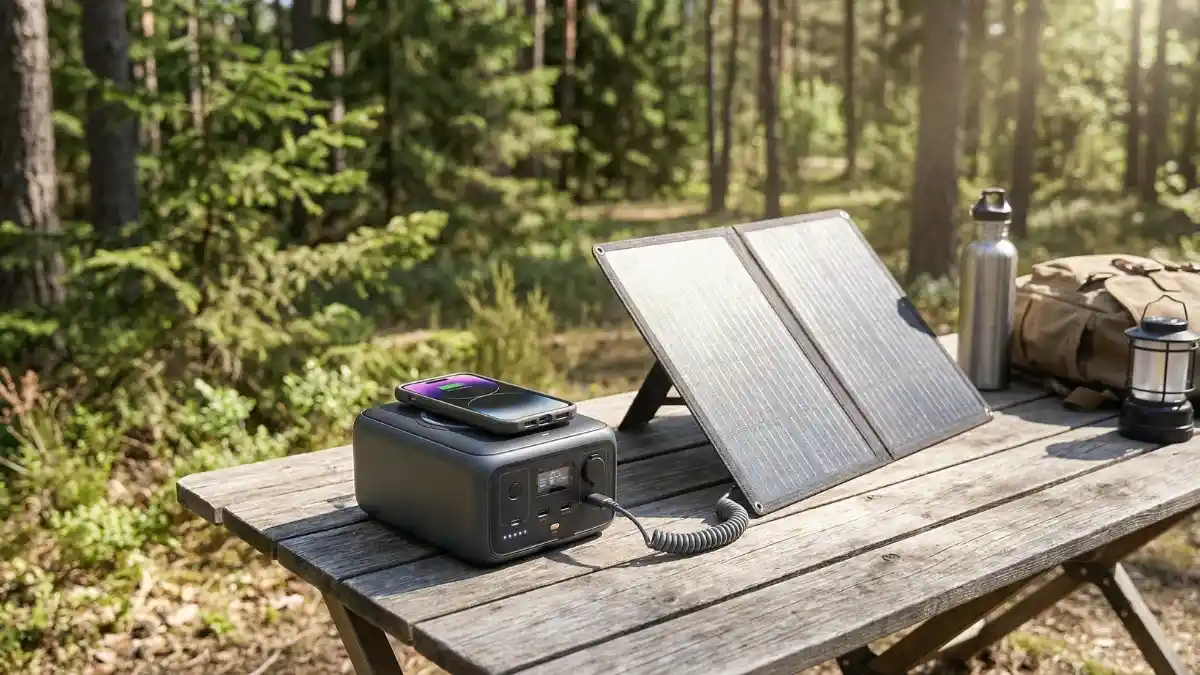
Phones, cameras, and small gadgets are essential when traveling or camping, but keeping them charged off-grid can be frustrating. A solar power bank with wireless charging solves that problem by combining three useful features in one device: battery storage, solar charging, and cable-free phone charging.
Instead of carrying multiple cables or searching for outlets, you place your phone on the charging pad and let the battery handle the rest. When paired with a portable solar panel, these devices provide practical backup power for camping, travel, and emergency outages.
In this guide, we’ll compare the best wireless solar power banks and compact solar power stations available in 2026, explain how they differ from traditional power banks, and help you choose the right model for your needs.
The challenge is that most “solar power banks” you see online are extremely small and recharge very slowly from sunlight. That’s why many campers now prefer compact solar power stations.
If you’re exploring solar-powered devices for everyday life, you may also enjoy our guide on “How Solar Gadgets Are Changing Daily Life”, which explains how portable solar technology is becoming more common in modern lifestyles.
This post may contain affiliate links. If you buy through them, I may earn a small commission at no extra cost to you.
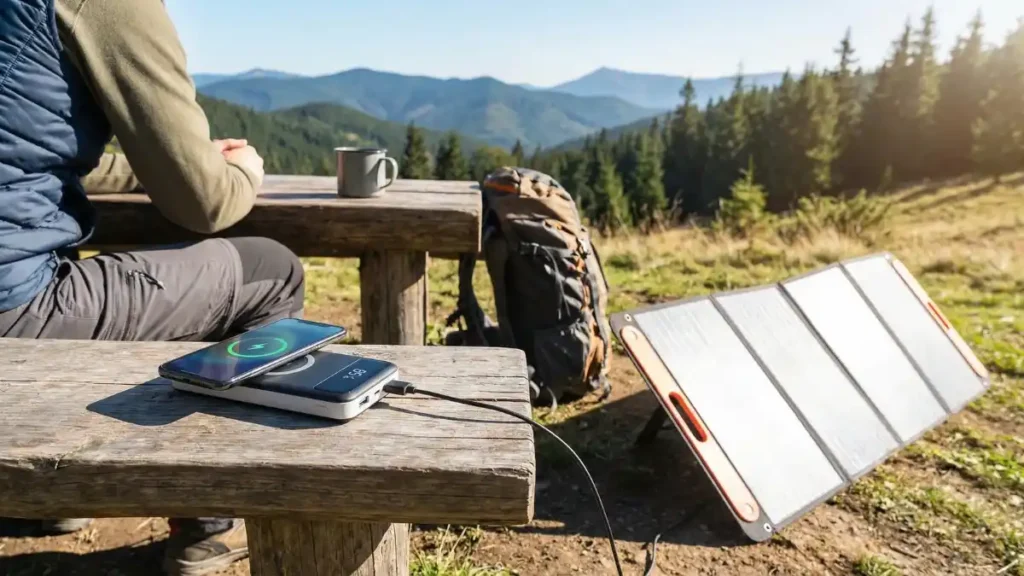
Table of Contents
Best Solar Power Banks with Wireless Charging (Quick Picks)
If you’re in a hurry and just want the best solar power bank for camping or weekend trips, start with these quick picks.
| Product | Battery Capacity | Wireless Charging | Solar Input | Best For |
|---|---|---|---|---|
| ALLPOWERS S200 | 154Wh | Yes | Up to 100W | Lightweight camping |
| EcoFlow RIVER 3 Plus Wireless | ~286Wh | Yes | Up to 220W | Travel & short trips |
| EcoFlow RIVER 3 Max Plus Wireless | ~858Wh | Yes | Up to 220W | Longer camping trips |
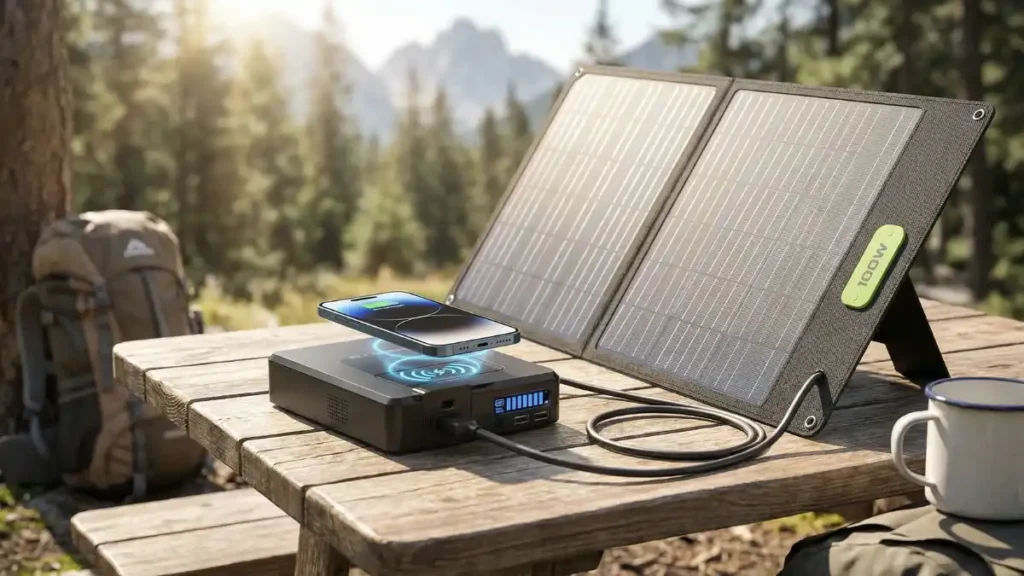
These devices bridge the gap between small power banks and full solar generators. They’re still portable, but offer significantly more battery capacity than typical phone chargers.
Best Solar Power Bank with Wireless Charging (Detailed Picks)
ALLPOWERS S200 Wireless Solar Power Bank
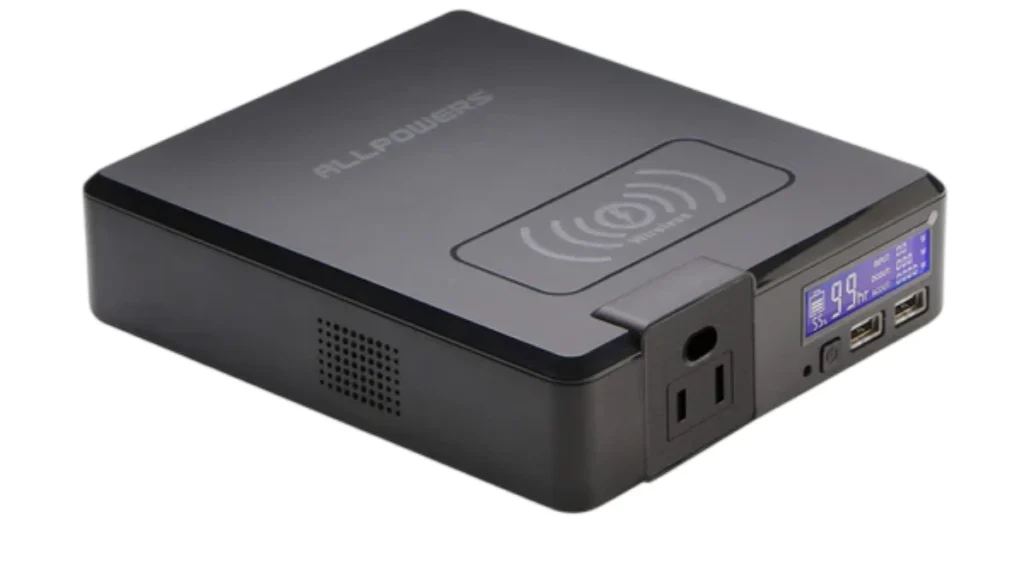
Quick Specs
| Feature | Specification |
|---|---|
| Battery Capacity | 154Wh |
| Wireless Charging | Yes (Qi wireless pad) |
| Solar Input | Up to 100W |
| Ports | USB-A, USB-C, AC outlet |
| Best For | Camping, travel, emergency backup |
| Weight | ~4.6 lbs (approx.) |
👉 Check Latest Price – ALLPOWERS Official Store
The ALLPOWERS S200 is one of the most compact portable power stations that includes a built-in wireless charging pad. Instead of plugging in cables, you can place your smartphone on top of the unit and start charging.
With around 154Wh of battery capacity, it can recharge most smartphones several times or power small electronics like cameras, lights, and tablets during camping trips or travel.
The S200 also includes multiple output ports, including USB-A, USB-C, and an AC outlet, making it flexible enough to power several devices at once.
When paired with a 60W–100W foldable solar panel, it becomes a practical off-grid power solution for outdoor trips or emergency backup.
Who This Power Station Is Best For
This model is ideal for:
- Campers who want a solar power bank for camping with wireless phone charging, without carrying extra cables
- Travelers looking for lightweight portable power
- Emergency kits for short power outages
- Users pairing it with 60W–100W portable solar panels
Pros
- Compact and lightweight design
- Built-in wireless phone charging pad
- Multiple charging ports for different devices
- Compatible with portable solar panels
Cons
- Smaller capacity compared with larger power stations
- Solar panel must be purchased separately
👉 Check Latest Price – ALLPOWERS Official Store
✔ Best for lightweight solar charging while camping or traveling, and a great entry-level solar power bank for camping.
👉 See Current Price & Availability
For a broader look at portable solar setups, see our guide on portable solar power for camping, travel, and outdoor use, which explains how portable solar systems work for travel and camping.
EcoFlow RIVER 3 Plus Wireless Solar Power Station
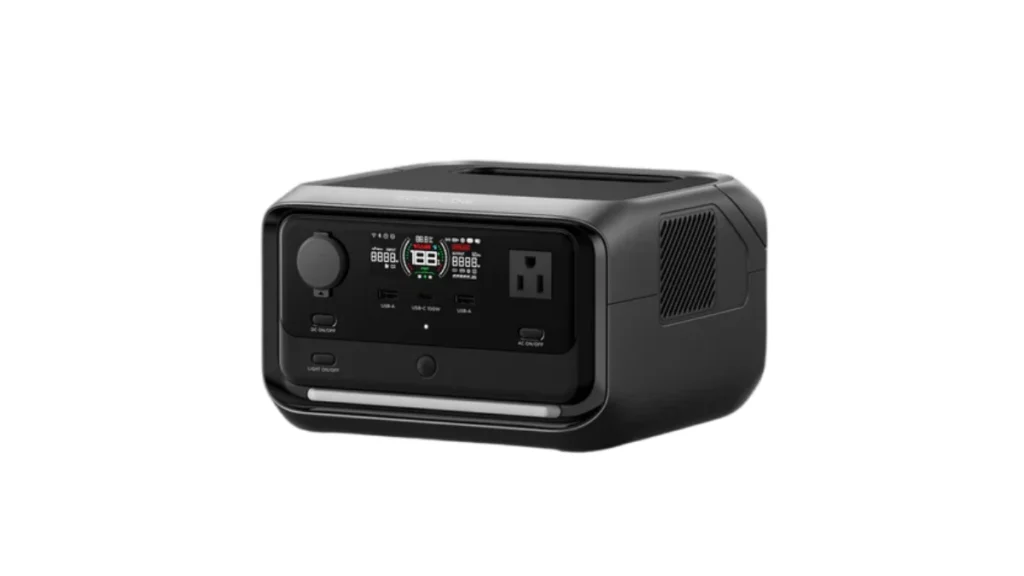
Quick Specs
| Feature | Specification |
|---|---|
| Battery Capacity | ~286Wh |
| Wireless Charging | Yes (15W magnetic wireless power bank) |
| Solar Input | Up to 220W |
| Battery Type | LiFePO₄ |
| AC Output | Up to 600W |
| Best For | Travel, home office backup, weekend camping |
| Weight | ~10–11 lbs (approx.) |
👉 Check Latest Price – EcoFlow Official Store
The EcoFlow RIVER 3 Plus Wireless offers a noticeable step up from smaller solar power banks in terms of performance and charging flexibility.
The unit includes a removable magnetic wireless power bank along with the main power station, allowing you to charge phones wirelessly without being tethered to cables. This is especially convenient during travel or when moving around a campsite.
With around 286Wh battery capacity, it can power more than just smartphones. Devices like laptops, routers, cameras, and drones can run comfortably from this compact unit.
Another major advantage is its fast solar charging capability. When paired with compatible portable solar panels, the system can accept up to 220W solar input, allowing significantly faster recharging than typical solar power banks.
Because of its UPS-style functionality and durable LiFePO₄ battery chemistry, the RIVER 3 Plus can also serve as a small emergency backup for home offices or networking equipment.
Who This Power Station Is Best For
This model is ideal for:
- Travelers who want portable solar backup power
- Digital nomads running laptops and camera gear
- Campers needing faster solar recharging
- Home offices requiring backup power for routers or small devices
Pros
- Fast solar charging support (up to 220W)
- Removable magnetic wireless charging power bank
- Reliable LiFePO₄ battery with long lifespan
- Multiple charging ports for different devices
Cons
- Heavier than small wireless solar power banks
- Higher price compared with compact models
👉 Check Latest Price – EcoFlow Official Store
✔ Best balance of portability, battery capacity, and solar charging speed.
👉 See Current Price & Availability
According to the U.S. Department of Energy, portable solar systems paired with battery storage are increasingly used for off-grid applications and emergency power solutions.
EcoFlow RIVER 3 Max Plus Wireless
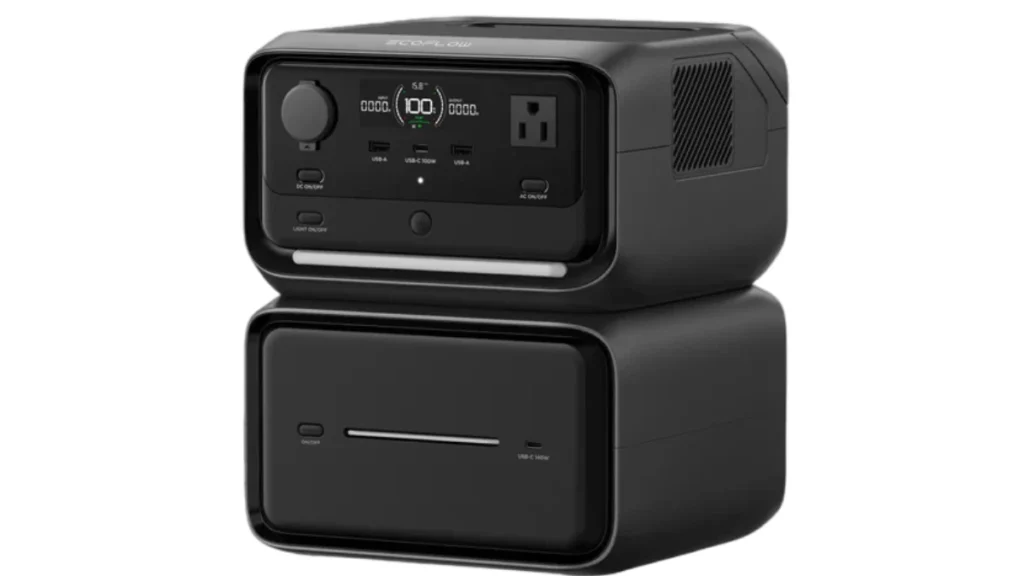
Quick Specs
| Feature | Specification |
|---|---|
| Battery Capacity | ~858Wh |
| Wireless Charging | Yes (wireless charging ecosystem) |
| Solar Input | Up to 220W |
| Battery Type | LiFePO₄ |
| AC Output | Up to 600W |
| Best For | Long camping trips, emergency backup |
| Weight | ~16–18 lbs (approx.) |
👉 Check Latest Price – EcoFlow Official Store
The EcoFlow RIVER 3 Max Plus Wireless is designed for users who need significantly longer runtime than typical portable power banks.
With around 858Wh of total battery capacity, it can keep multiple devices running for extended periods. That includes smartphones, laptops, lights, routers, and even small camping appliances.
Despite the larger battery, the system remains fairly portable compared with traditional solar generators. It still includes EcoFlow’s fast charging technology, quiet operation, and compatibility with high-output portable solar panels.
For campers, van travelers, or households preparing for outages, this model provides a much more robust backup power solution while still supporting convenient wireless phone charging.
When paired with 100W–200W portable solar panels, the RIVER 3 Max Plus becomes a practical small solar generator for multi-day off-grid use.
Who This Power Station Is Best For
This model is ideal for:
- Campers needing multi-day power during outdoor trips
- RV or van-life setups requiring reliable off-grid electricity
- Homes, preparing for longer power outages
- Users running multiple devices at the same time
Pros
- Large battery capacity for extended runtime
- Fast solar and AC charging capability
- Reliable LiFePO₄ battery technology
- Supports multiple devices simultaneously
Cons
- Larger and heavier than compact models
- Higher upfront cost
👉 Check Latest Price – EcoFlow Official Store
✔ Best choice for extended camping trips and serious backup power.
👉 See Current Price & Availability
If you’re interested in larger solar backup systems, our guide on “2000Wh Solar Generator: Best Options for Emergency, Camping & Home Backup” explains high-capacity solar generators for home backup and emergencies.
Alternatives Without Wireless Charging
Wireless charging is convenient, but some reliable portable power stations skip it in favor of larger battery capacity.
Two popular alternatives include:
BLUETTI EB3A Portable Power Station
- Compact and reliable
- LiFePO₄ battery
- Strong solar charging performance
Jackery Explorer 300 Plus
- Very beginner-friendly
- Excellent ecosystem of solar panels
- Reliable camping power solution
These units require charging cables for phones, but still perform well for portable solar setups.
Solar Power Bank vs Solar Power Station
Many buyers mix up these two categories.
Here is a simple comparison:
| Feature | Solar Power Bank | Solar Power Station |
|---|---|---|
| Battery capacity | 5,000–30,000 mAh | 150Wh–2000Wh+ |
| Devices supported | Phones & small gadgets | Phones, laptops, appliances |
| Solar charging speed | Slow | Faster with larger panels |
| Portability | Pocket size | Small suitcase size |
Power stations use Wh (watt-hours), while smaller power banks typically use mAh (milliamp-hours).
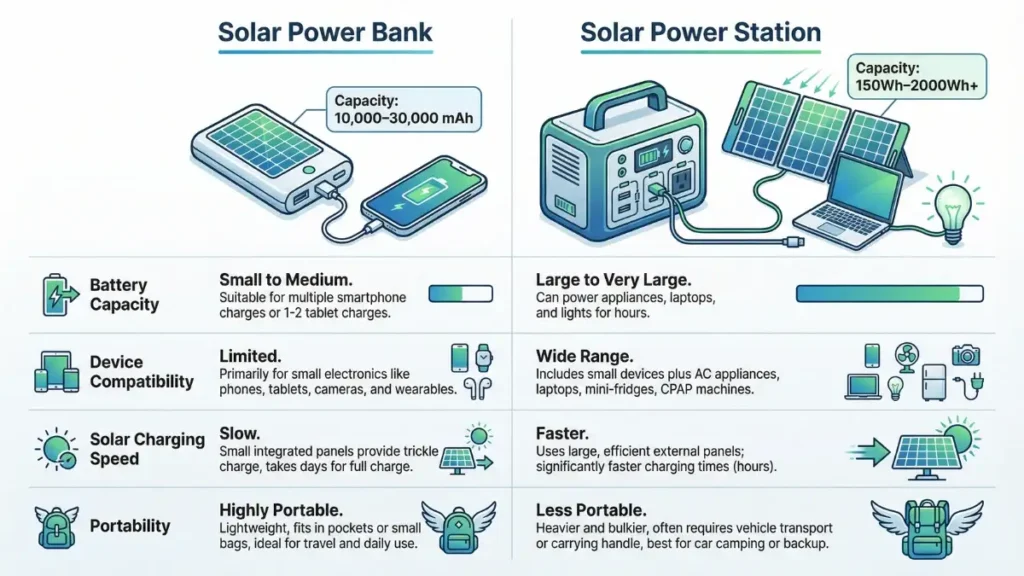
In simple terms, the difference is:
- Solar power banks are best for phones and small gadgets.
- Solar power stations are better for camping, outages, or running multiple devices.
Research from theNational Renewable Energy Laboratory (NREL) shows that solar-plus-storage systems store excess solar energy and supply it when needed, improving reliability during outages or low sunlight.
How to Choose a Solar Power Bank with Wireless Charging
When comparing models, these practical factors matter more than marketing specs.
Battery Capacity
For basic phone charging, smaller units work fine.
For camping trips or emergency backup, 150Wh or more provides much more flexibility.
Wireless Charging Speed
Most devices support 5W–15W wireless charging.
Higher wattage improves charging speed.
Solar Charging Performance
Built-in panels on small power banks are usually slow.
Portable foldable solar panels dramatically improve charging speed and efficiency.
Durability
Outdoor gear should have:
- Sturdy casing
- Protected ports
- Reliable battery protection
Portability
Backpack travelers may prefer smaller units, while car campers can carry larger power stations.
If you’re hiking or traveling light, every extra kilogram matters, so portability becomes just as important as battery capacity.
Are Solar Power Banks Worth It?
Yes, but only if you understand their limitations.
Small built-in solar panels usually charge the battery very slowly. In most cases, they act as backup trickle chargers rather than primary charging sources.
Where these devices shine is in convenience.
A wireless solar power bank lets you:
- Recharge phones while camping
- Keep gadgets running during outages
- Maintain power in emergency kits
- Reduce reliance on wall outlets
When paired with a portable solar panel, they become far more practical for off-grid use.
Best Solar Panels to Pair with Your Solar Power Bank
Using a portable panel significantly improves charging speed.
ALLPOWERS 60W Foldable Solar Panel
A good match for smaller power stations like the S200.
It balances portability and charging performance.
👉 Check Latest Price – ALLPOWERS Official Store
ALLPOWERS 100W Portable Solar Panel
Better suited for medium-sized power stations like the EcoFlow RIVER series.
With strong sunlight, a 100W panel can recharge batteries much faster during camping trips.
👉 See Current Price & Availability
Frequently Asked Questions
Do solar power banks really charge from sunlight?
Yes, but charging speed depends on panel size and sunlight conditions. Built-in panels usually charge slowly.
How long does solar charging take?
With a 60–100W panel, recharging a 150–300Wh battery typically takes most of a sunny day.
Is wireless charging slower than cable charging?
Yes. Wireless charging is usually less efficient than cable charging.
Can a solar power bank charge a laptop?
Most small power banks cannot. Larger portable power stations can power laptops through AC or USB-C outputs.
Are solar power banks useful during emergencies?
Yes. They provide backup power during outages, especially when paired with solar panels.
Quick Recommendation
If you want a fast answer without reading the full guide, these are the top picks:
Best Lightweight Wireless Solar Power Bank
ALLPOWERS S200 – Compact, portable, and perfect for camping, travel, and charging phones or small gadgets off-grid.
Best Overall Performance
EcoFlow RIVER 3 Plus Wireless – A balanced option with stronger battery capacity, faster solar charging, and reliable everyday backup power.
[View EcoFlow RIVER 3 Plus Deals]
Best High-Capacity Option
EcoFlow RIVER 3 Max Plus Wireless – Ideal for longer camping trips, emergency outages, or powering multiple devices.
[See EcoFlow RIVER 3 Max Plus Offers]
Tip: Pair any of these with a 60W–100W foldable solar panel to recharge faster during outdoor use.
Final Verdict
The best solar power bank with wireless charging depends on how you plan to use it.
- ALLPOWERS S200 – lightweight and practical for camping and travel
- EcoFlow RIVER 3 Plus Wireless – balanced capacity and portability
- EcoFlow RIVER 3 Max Plus Wireless – best for longer trips and emergency backup
For best results, pair your device with a portable solar panel. This combination provides reliable off-grid power for camping, travel, and emergency preparedness.
About the Author

SolarGizmoGuide is an independent solar research and publishing platform focused on practical, real-world solar solutions for urban homes and apartments. Our editorial team analyzes solar gadgets, mounting systems, backup power systems, and portable solar technology to help readers make informed investment decisions.
All content is based on independent research, manufacturer technical documentation, and publicly available performance data. Articles are reviewed and updated periodically to reflect current installation standards, safety considerations, and evolving solar technology.