
Last Updated on May 7, 2026 by dhruwuttam58@gmail.com
Introduction: Why Home Backup Power Matters Now
If the grid is down, it’s not always an isolated, quick event. Long-lasting power outages are becoming more frequent, driven by extreme weather and aging infrastructure, according to U.S. Energy Information Administration grid reliability data.
On average, U.S. electricity customers experience several hours of outages per year. For those living in the most vulnerable areas, power outages can last for days or longer (average annual outage duration in the U.S.).
Utilizing a solar generator for home backup has evolved from being a luxury item to a practical plan of action. Instead of running a costly diesel generator or sitting in the dark, homeowners can now use quieter, more efficient alternatives when they need them most. But knowing which solar solutions are effective during an outage and which may not perform as expected is vital. Many homeowners discover that the solar panel they installed won’t work during blackouts, or that they’ve invested in the wrong system for their situation.
This guide will walk you through the realities of solar generators for home backup: how they work, what won’t work, the capacity you really need, and the best time to consider investing in these systems.
Table of Contents
The Core Problem: Why Your Solar Panels Don’t Work During a Blackout
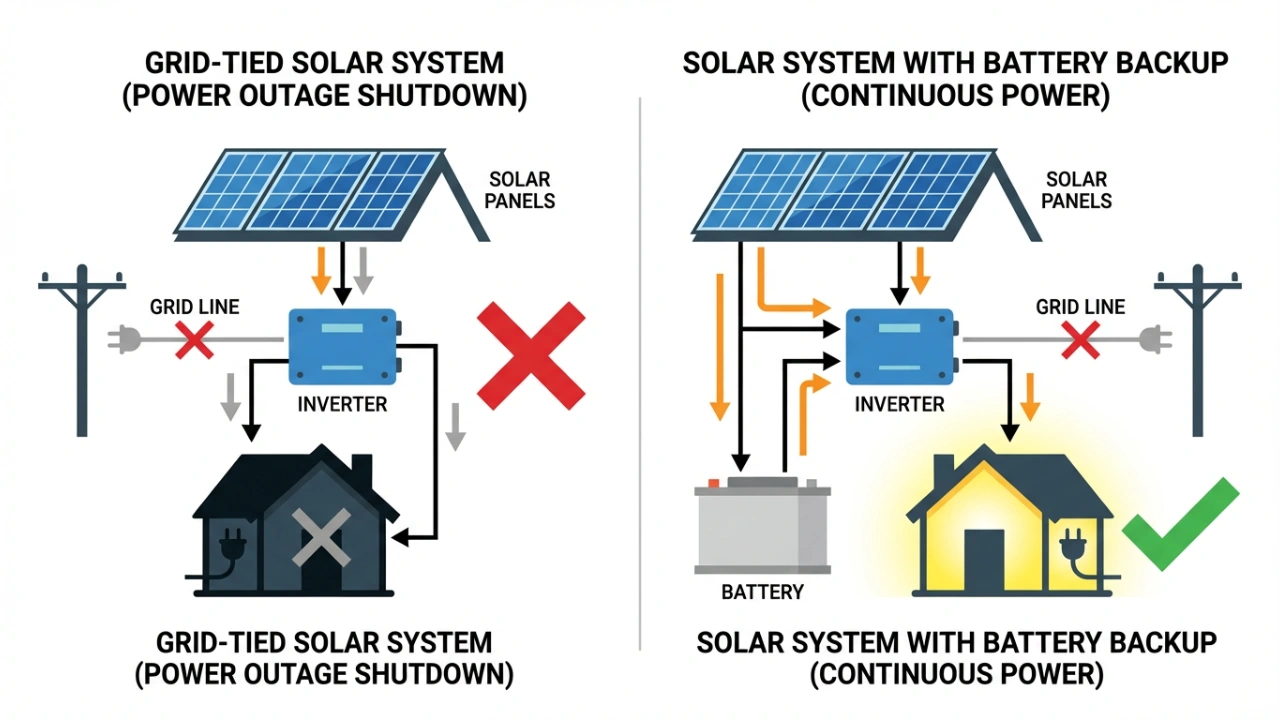
The truth is that many homeowners are unaware until an outage occurs: a conventional solar panel system won’t keep your home running during a power failure.
If you own grid-tied solar systems — the most popular residential setup — your solar panels will continue to produce electricity during daylight hours, regardless of when the grid is not functioning. But you’re not able to utilize that energy. The system shuts off on its own.
Why the Automatic Shutdown?
The safety feature, known as anti-islanding, requires grid-tied inverters to disconnect automatically during outages to prevent back-feeding and protect utility workers, according to the U.S. Department of Energy.
If power lines are damaged, utility workers must repair them. If your solar-powered inverter pumps power back into the grid while workers are repairing the damage, it could electrocute the repair team. Anti-islanding prevents this by detecting grid failure and halting power output. The inverter continuously monitors grid voltage and frequency and will disconnect within the time windows required by applicable interconnection standards and utility rules.
Without this safeguard, solar panels could create an “electricity island,” a part of the grid that is still generating electricity, even though people believe that it’s not being energized. It’s a public safety measure, even though it leaves homeowners powerless during their darkest moments.
The Solution: You Need More Than Panels
To harness solar power during power outage durations, you need battery storage integrated into the system. Batteries act as an interface between your solar panels and your home’s electrical circuits. They store surplus solar energy produced during the day and release it when the grid goes out of service, allowing your inverter to power critical appliances without back-feeding the grid.
The system is transformed from grid-connected (grid-dependent) to hybrid (grid-connected with battery backup).
Three Types of Home Solar Systems: Which One Actually Backs You Up
Knowing the differences between these systems is crucial in making the right decision.
1. Grid-Tied Solar (No Backup)
What it does: Solar panels generate DC power. Inverters convert it to AC power. Any excess feed is fed back to the grid. You are credited to your electric bill (net metering).
During a blackout: The system shuts down. Zero power available.
Ideal for: Homeowners only interested in reducing their electric bills without worrying about outages.
Price: Lowest upfront investment.
This is why it’s not possible to think of solar panels as equivalent to backup power. Grid-connected systems are optimized to supply power to utility companies, not to store power for your personal use.
2. Hybrid Solar + Battery (Backup Ready)
What it does: Solar panels generate power; the battery storage system is charged. If the grid fails, the system shuts down and operates using battery energy. Solar panels can also charge the battery throughout the day, thereby extending the backup capacity.
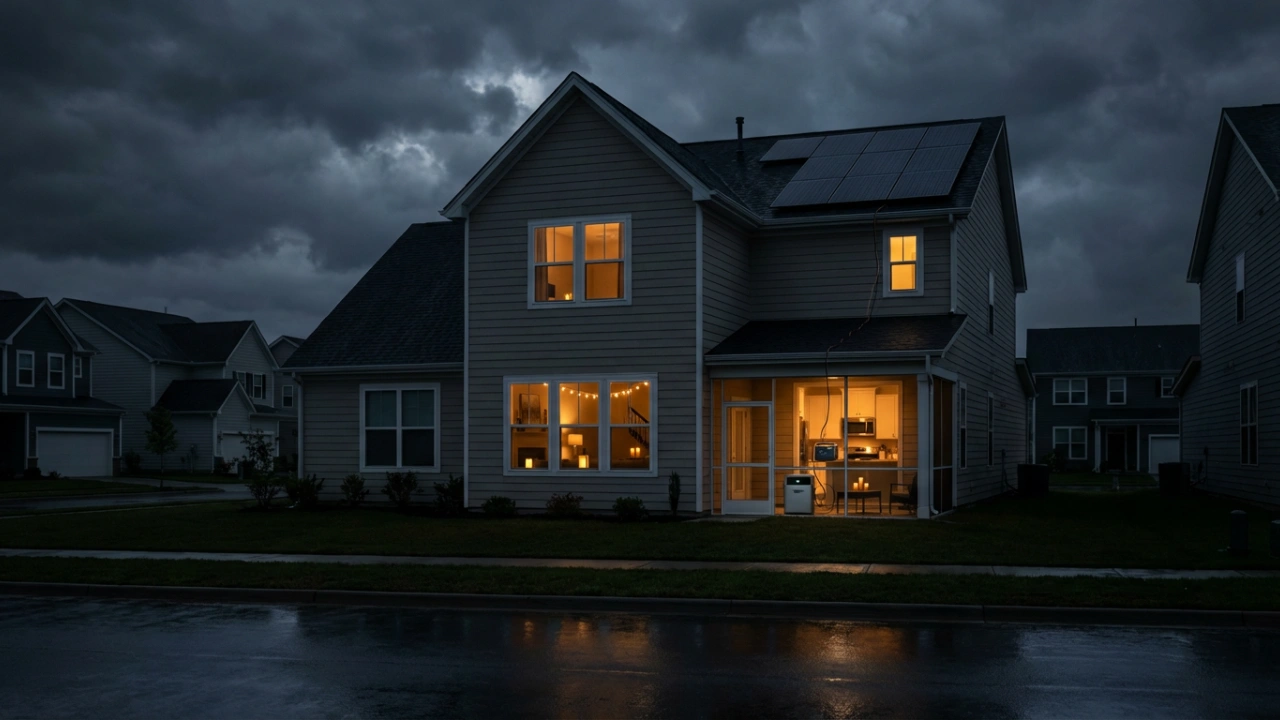
During a blackout: The system automatically switches to battery power in milliseconds. Critical circuits will remain in operation.
Ideal for: Homeowners looking to lower power bills and protection against outages.
Price: Higher upfront cost (panels, battery, and hybrid inverter). However, it provides a dual benefit.
This is the ideal middle ground for most homeowners. It reduces your dependence on the grid all year round while ensuring backup power in times of need.
3. Off-Grid Solar (Complete Independence)
What it does: Solar panels charge large battery banks. The battery bank powers the home directly—no grid connection is required. Generator backup is available during long periods of cloudy weather.
During a blackout: You’re already off-grid, so “blackouts” don’t apply. The system is always running, regardless of its size.
Ideal for: Rural properties far from utility lines, homesteaders, and properties with unreliable grid service.
Price: Highest upfront cost; however, it eliminates all utility bills for life.
Off-grid systems are not suitable for the vast majority of suburban homeowners and require a professional design approach to avoid prolonged battery drain in poor weather.
How a Solar Generator for Home Backup Actually Works During an Outage
Let’s look at an actual scenario to better understand the mechanism.
Thursday, 2:00 PM: Blackout Strikes
Your home cannot use grid power. The hybrid inverter immediately detects grid problems through voltage and frequency monitoring. In about 10 to 50 milliseconds, it is disconnected from the grid and starts drawing energy directly from the battery.
If your battery is fully charged and it is warm outside, two things can happen simultaneously:
- Your battery provides AC electricity to crucial circuits (fridge, lights, medical equipment, router). Your home automatically switches to battery power – no need for manual intervention. For extended blackouts, adding dedicated “solar emergency lights for power outages”, can provide reliable lighting without draining your main battery system.
- The solar panels keep charging the battery throughout daylight hours. Inverters convert solar power to the home’s electrical loads while charging the battery for use at night.
Thursday, 6:00 PM: Sun Sets
Solar input stops. Your home now runs using battery energy stored. The battery is discharged, powering the essential appliances through the night.
Friday, 6:00 AM: Sun Rises
Solar generation resumes. The battery can recharge. If the problem persists, it will repeat every day. Solar panels generate power during the day, while batteries provide power on cloudy days and at night.
Friday, 3:00 PM: Grid Restores
The inverter can detect the grid’s frequency and voltage, and return them to normal. This system then reconnects and resynchronizes with the grid. Your battery is charged from both grid and solar electricity (whichever you have). The battery is prepared to activate automatically during the next power failure.
What Actually Powers Your Home
During an outage, the energy hierarchy includes:
- Solar power immediately (first priority, when the sun is available)
- Storage of battery energy (covers nighttime, cloudy hours, and high-demand periods)
- Generator for backup (optional, Third layer only available in hybrid generator systems)
Your battery is the proper backup. Solar is the battery’s “refuelling” mechanism.
Backup Power Capacity: How Much Do You Actually Need?
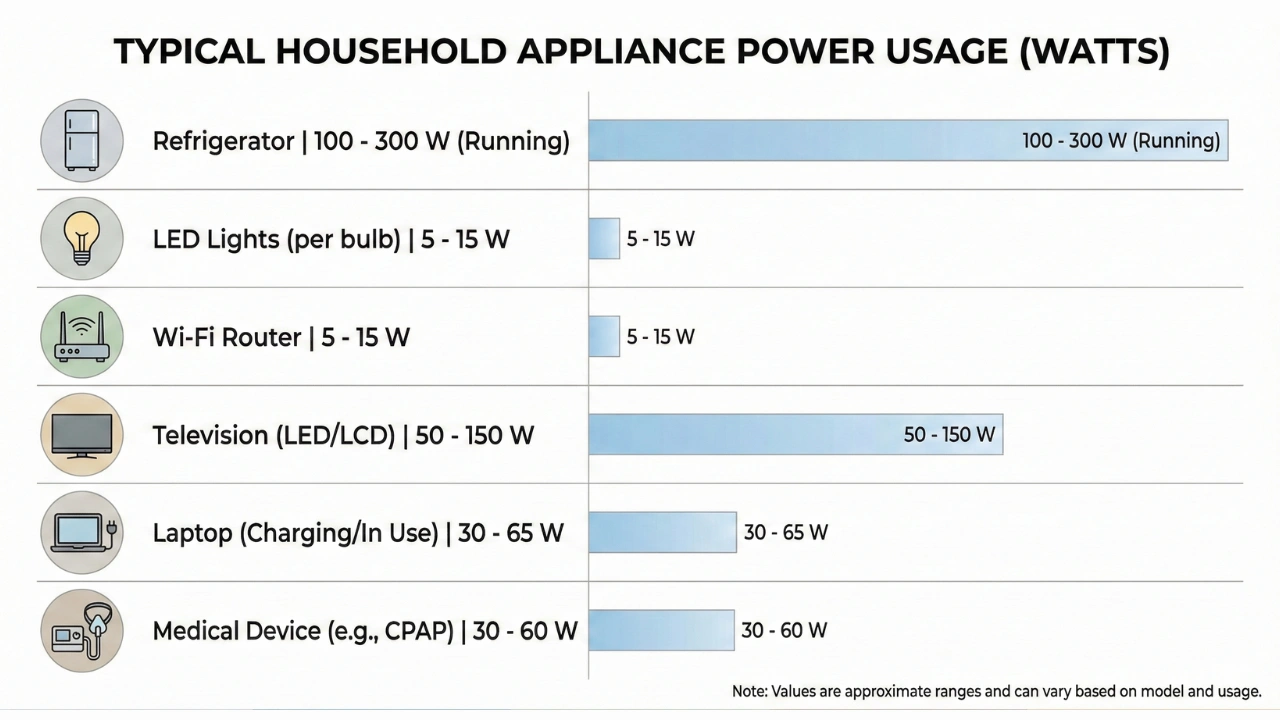
The majority of discussions end up going wrong. Manufacturers often advertise 8 kWh battery packs as ‘whole-home backup,’ but this claim is misleading for most households. 8 kWh sounds like a lot until you look at the numbers.
Real-World Numbers
An average U.S. household uses about 20–30 kWh of electricity per day, according to data from the U.S. Energy Information Administration. If you want more detailed information on system sizing, this guide on “How Many Solar Panels Does a House Really Need?” explains how daily energy consumption translates into panel and battery requirements. It’s not necessary to back up the entire house. It is essential to back up your crucial load — the circuits that will keep you well-informed, safe, and connected during an outage.
Scenario: A 4-Person Home During a 24-Hour Outage (No Solar Recharge)
Critical Loads Breakdown
- Refrigerator: 0.5 kW, runs ~8 hours/day = 4 kWh/day
- LED lighting (5 rooms, minimal use): 0.1 kW, runs ~6 hours/day = 0.6 kWh/day
- Wi-Fi router + modem: 0.015 kW, runs 24 hours = 0.36 kWh/day
- Phone/laptop charging: 0.05 kW, 4 hours = 0.2 kWh/day
- Electric well pump (if applicable): 0.75 kW, runs 2 hours = 1.5 kWh/day
- Medical equipment (CPAP machine, oxygen concentrator): 0.3 kW, runs ~8 hours = 2.4 kWh/day
Total critical load: ~9.06 kWh per day
Battery Sizing
For example, if a household needs about 10 kWh per day and a typical battery is rated at 80 % usable depth of discharge, a battery bank of around 12 kWh or more is recommended to ensure reliable backup capacity (SunWatts).
This is why it is commonly recommended as a practical backup size for homeowners with an average home — it’s not an arbitrary number. It can provide a full day’s worth of necessities without relying on sunlight.
Incorporating Solar in the Equation
The math has changed. When solar cells are recharged throughout the day:
A typical 5 kW residential solar system can produce roughly 20–25 kWh per day under good sunlight conditions, according to estimates from the National Renewable Energy Laboratory (NREL). If 8-10 kWh are used for the daytime load and then the battery is recharged, the 10kWh battery can provide power backup for as long as the weather remains good.
The Reality: With battery and solar, it is designed to provide extended solar power during power outage periods, as long as you’re getting regular sunshine. In the absence of solar, your battery’s capacity will determine how long your backup lasts.
If You Want Whole-Home Backup
Proper home-based backup (refrigerator, lighting, HVAC, water heater, dryer, and the range) requires:
- 20-40 kWh capacity of the battery (depending on your usage habits and the conditions)
- A robust solar array (8-15 kW)
- Cost of installation ($30,000-$80,000+)
The majority of homeowners don’t require this. The backup for crucial loads can be adequate to protect your home and provide essentials.
Cloudy Day Considerations
Solar panels still generate energy on cloudy or overcast days, but real-world performance can drop significantly compared with bright sunshine because irradiance levels are lower (CED Engineering). If you live in Seattle or the Pacific Northwest, cloudy periods are the norm. This is why many homeowners combine batteries and solar power with an emergency generator to manage prolonged cloudy conditions.
Your Real Options: Installed Systems vs. Portable Solar Generators for Home Backup
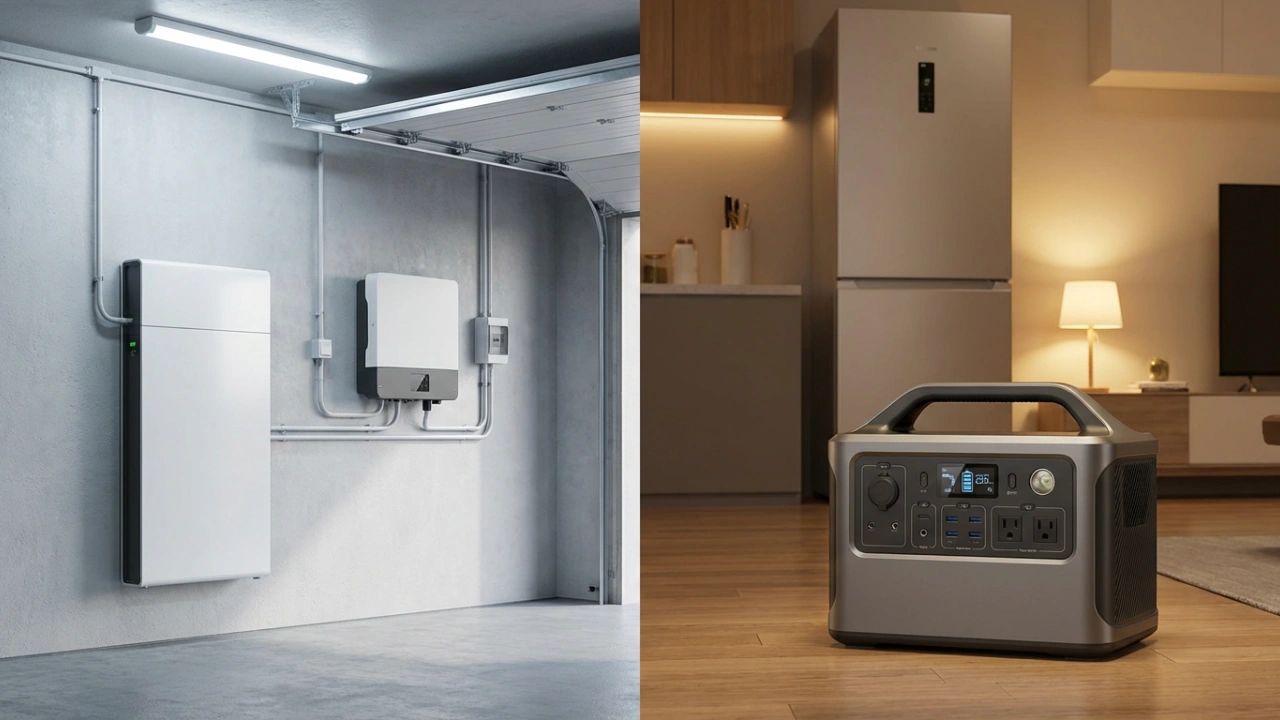
There are two distinct routes to home battery backup. Knowing the benefits and drawbacks of each solar backup generator for the home is vital.
Path 1: Installed Hybrid Solar + Battery System
What are you installing:
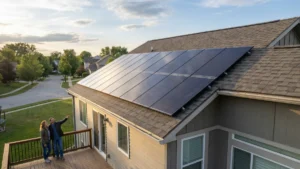
- Solar panels for the roof (6-15 panels, based on the system’s size)
- Garage battery system or wall mount outside
- The hybrid inverter (converts DC generated by batteries and panels to AC to power your home)
- Intelligent transfer switch, or integrative disconnect (for the automatic switching of grids and batteries)
- Professional wiring permits grid interconnection approval
Installation timeline: 2-4 weeks (design, permitting, installation, inspection, grid approval).
Many backup system failures are caused by design and wiring errors, so understanding common “solar inverter installation mistakes” can prevent expensive problems later.
Advantages:
- Permanent installation; always ready
- Incorporated into the electrical system in your home
- The system can power multiple circuits simultaneously
- Lower long-term costs (no fuel purchases, minimal maintenance)
- In the U.S., the Residential Clean Energy Credit is 30% for eligible solar (and qualifying battery storage) through 2032 under current law (IRS Residential Clean Energy Credit).
- Improves the home’s value
Disadvantages:
- The higher initial cost ($15,000-$50,000+ based on the system size)
- It requires an area on the roof (or the ground mount, in case the roof is not suitable)
- Apartment dwellers may face approval hurdles from strata boards
- Inspections and permits can be lengthy
- Battery storage systems degrade over time, and expected useful life can vary widely depending on chemistry and use patterns. Analysts consider battery degradation behavior as an important factor when planning long-term backup capacity (Clean Energy Group).
The best choice for: Homeowners with a single-family home or homes that have stable grid service with occasional outages, and those who wish to lower the cost of electricity all year long.
Path 2: Portable Solar Generators
System components:
- Battery unit portable (500Wh to 5000Wh range)
- Inverter integrated
- Solar panels that are separate or integrated (100W up to 400W)
- USB ports, AC outlets, and occasionally 12V ports
- Carries as a huge suitcase, or rests on the floor
Setup time: Unbox, place in location, connect solar panel, plug in devices. 30 minutes.
Advantages:
- The lowest initial cost ($500-$3,000)
- There are no permits, installations, or inspections
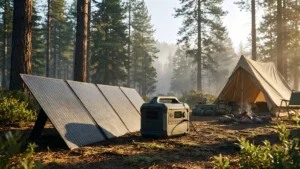
- Portable—move between rooms, go camping, and have power when there are outages wherever you are.
- Quick backup without having to wait for approval
- No monthly finance; buy one-time
- Ideal for apartment renters
Disadvantages:
- It is typically designed to power one room or a limited number of essential devices at once.
- The capacity of batteries has been reduced (requires making a list of devices that should be charged first)
- Slower charging from the sun (6-12 hours to complete a charge during a cloudy, rainy day)
- Manually move between rooms
- The solar output decreases over a period of 10+ years.
- Costs for recurring replacement (portable units usually last for 5-7 years)
- It is not connected to circuits for home use (can’t run a refrigerator without an extension cord)
Ideal for: Apartment dwellers and renters; Backup for essential lighting and communications; Event or camping use only; Homeowners evaluating backup power before committing to the whole system.
The Hybrid Approach: Solar + Portable Generator
Many prepared homeowners use both: a smaller portable generator for everyday emergencies (quick blackouts, short outages) and plan a larger installed system for long-term resilience. This provides immediate, portable backup while planning the permanent installation.
Installation Considerations: Not All Homes Are Equal
Single-Family Homes: Straightforward Path
Roof suitability: Check for an unshaded south-facing roof (a minimum of 20 square meters is required for an average-sized system).
Structural: Physical and structural considerations — such as roof age, available space, shading, and local building codes — are key when planning to install solar panels and battery systems on a home (Clean Energy Group).
Electrical: The primary circuit requires space for a breaker and interconnection equipment.
Timeline: 3-4 weeks from application to backup-ready.
Challenges: Usually minimal. The majority of homes are working.
Apartments and Condominiums: Major Barriers
Access to roofs: A shared rooftop requires authorization from the homeowners’ association (HOA) or condo board. One objector could hinder the installation. Some buildings ban alterations.
Electrical infrastructure: Buildings with multiple units are connected to a single main switchboard. Each unit’s wiring for hybrid backups requires working with complex shared electrical systems and with building regulations.
Battery storage space: Limited basement, laundry, or closet space to accommodate batteries.
Structural load: Strata must approve roof modifications and weight distribution.
Practical realities: Apartment residents should focus on portable solar generators (as the primary backup) and should advocate for large-scale solar and battery systems for buildings (a long process, with many political issues).
Rented Homes: Your Landlord’s Say
The simple answer: The majority of leases prohibit permanent electrical changes. Roof-mounted systems are generally not permitted.
Portable backups: Your only legal alternative. Portable generators with 2000Wh provide real-time backup for lighting, refrigerators, and medical devices (with intelligent management) without requiring landlord permission.
Negotiation: Certain landlords will allow portable systems, provided you show security compliance. Fewer allow portable panel installation.
Solar Generators vs. Traditional Fuel Generators: A Practical Comparison
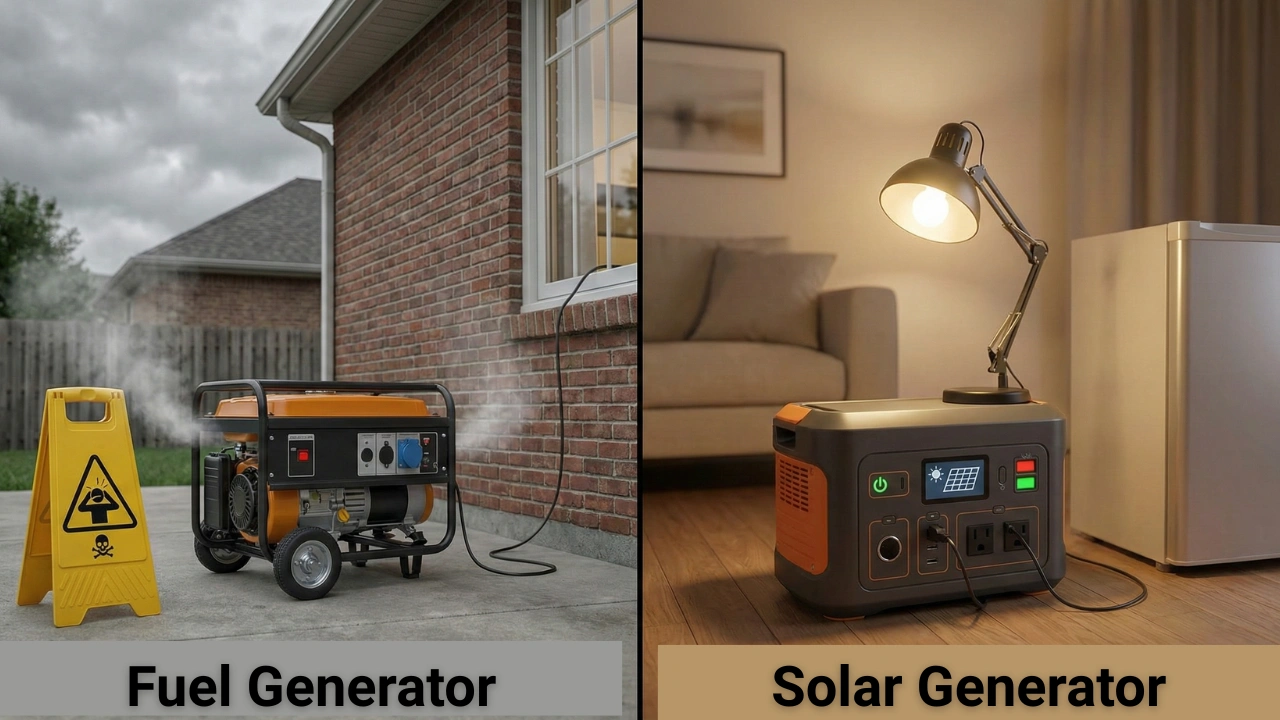
When you can’t install a permanent system, which emergency backup should you choose?
| Factor | Solar Generator | Fuel Generator |
|---|---|---|
| Operating noise | 20–30 dB (nearly silent) | 70–90 dB (vacuum cleaner level) |
| Carbon monoxide risk | None (safe for nearby use) | Extremely dangerous if used indoors; must operate outside 20+ feet away |
| Fuel requirements | None (solar recharges free) | Requires gasoline, propane, or diesel stored on property |
| Long-term fuel costs | Zero (solar is free) | $50–$200/month if run regularly; fuel degrades if stored long-term |
| Maintenance | Minimal (keep panels clean) | Regular: oil changes, spark plug replacement, seasonal startup |
| Upfront cost | $1,500–$3,000 for adequate backup | $500–$2,000 for portable unit |
| Power output | 1,500–3,000W typical | 5,000–7,000W typical |
| Recharge during outage | Yes (sunlight is available) | No (unless you have fuel supply) |
| Extended outages (3+ days) | Effective if sunny | Better (fuel provides continuous power) |
| Extended outages (3+ days, cloudy) | Limited (slow solar recharge) | Better (fuel independent) |
Battery systems are typically much quieter than combustion generators; published noise ratings vary by model and measurement distance (National Institute for Occupational Safety and Health (NIOSH) noise guidance).
Gasoline-powered portable generators produce carbon monoxide, a colourless, odourless gas that can be fatal if used indoors or too close to enclosed spaces. The U.S. CPS highlights that CO buildup can kill quickly and recommends keeping generators outdoors and far from openings.
Verdict: Solar generators are superior for outages of 48 hours or less in decent weather. Traditional generators win for long outages, fuel-independent power, and high-load demands. Many prepared homeowners keep a small fuel generator (propane models don’t degrade in storage) as a secondary backup for multi-day outages, combined with a solar generator for daily emergencies.
Common Mistakes & Misconceptions Homeowners Make
Mistake 1: “I Have Solar Panels, So I Have Backup Power”
The common misconception. Without batteries, solar panels will be inactive during a blackout.
The solution: Ask your installer whether the system you are installing has a grid disconnect and battery storage capability. If not, it’s a problem—no outage backup.
Mistake 2: “A 5 kWh Battery Will Power My Whole House.”
From a practical standpoint, this is inaccurate. A 5 kWh battery could power your refrigerator for 12 hours or the entire critical circuits of your home for about 6 hours. Home backups require 20+ energy units.
The solution: Calculate your critical loads (fridge, lights, medical equipment) in isolation from the high-end loads (AC, dryer, range). The battery should be sized to meet only the needs of the most critical load.
Mistake 3: “I’ll Just Size My Battery as Large as Possible”
Over-sizing can be unnecessarily costly and inefficient. A battery that sits inactive between outage cycles slowly declines, without any benefit.
The solution: Match battery capacity to the expected load. A modular system allows you to expand capacity in the future if your requirements shift.
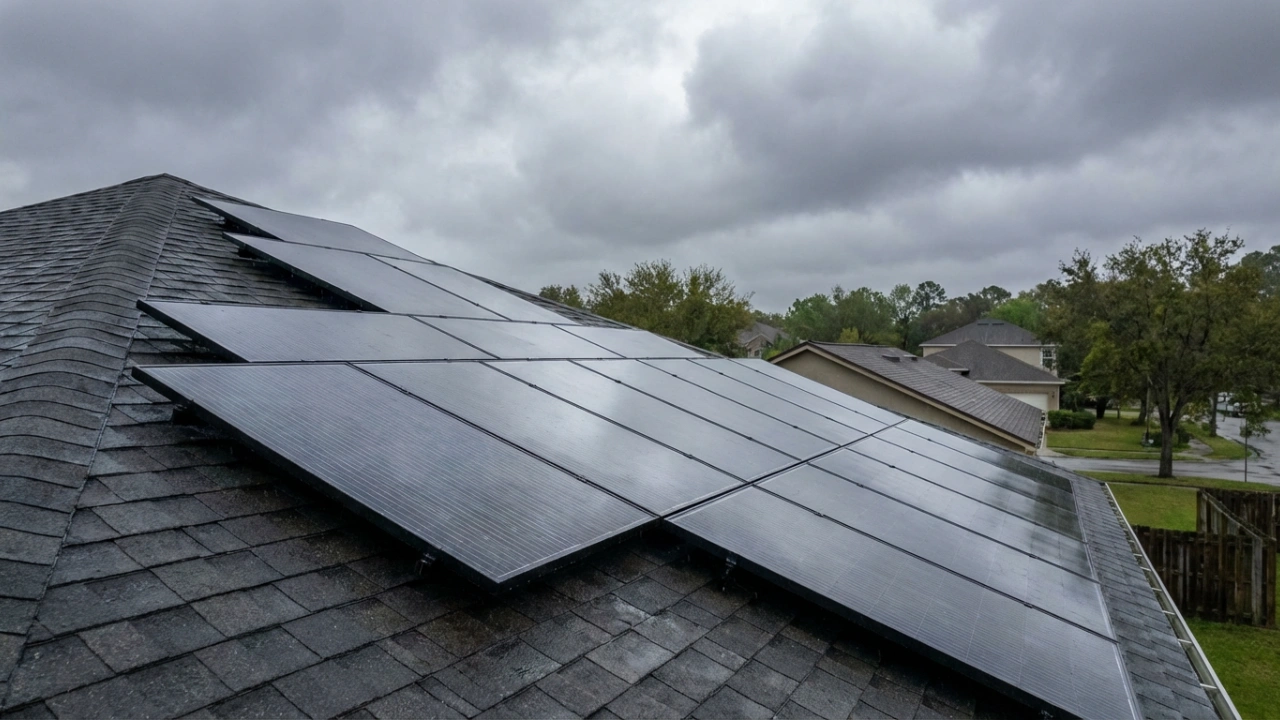
Mistake 4: “Solar Works Fine on Cloudy Days”
It’s true, but they’re not always reliable as a backup. On a cloudy day, the output is 20-30% of what it would be on a sunny day.
On a grey day, an average 5 kW solar array may produce only a few kilowatt-hours, compared to 20+ kWh on a clear day. If your home’s consumption is 10 kWh, it operates at an energy deficit. Your battery will deplete. After two or three days of continuous rain, the backup stops working.
The solution: Plan battery capacity for 1-3 days without solar power, based on regional weather patterns. If you live in the Pacific Northwest, you need more batteries than those in Arizona.
Mistake 5: Ignoring Surge Wattage
Many compressor-driven appliances have a startup surge higher than running power; inverter sizing should account for surge ratings (U.S. Department of Energy appliance energy guidance).
The motor of a refrigerator draws 3-4 times its running wattage when it first starts. A 500W running fridge needs 1,500W peak. Many portable solar generators are designed to provide continuous power but lack surge power. You plug in the fridge, and the system shuts down due to overload.
The solution: Read specs carefully. Check for surge wattage, not just the running power. Consider surge loads during startup when sizing your inverter.
Mistake 6: “The Battery Will Last Forever”
Lithium (LFP) batteries are long-lasting, but they do degrade over time. According to NREL battery degradation research, many residential battery warranties specify a minimum retained capacity after a set term (often 10 years), and real-world degradation depends on cycling, temperature, and operating range.
The solution: Budget for battery replacement over the next 10 years as part of long-term planning. It’s not an absolute loss, as degraded batteries can still be used as backup, just with fewer hours.
Mistake 7: Not Accounting for Night and Cloudy Days
The idea of a battery with 10 kWh built around the solar output on sunny days can work till it begins to rain for two days. At that point, your backup capacity may be depleted.
The solution: Design around your region’s worst-case scenario. Pacific Northwest homeowners need larger batteries than Southwest homeowners with the same size solar panel.
Who Should Invest in Solar Backup Power—And Who Shouldn’t
Excellent Candidates for an Installed Hybrid Solar + Battery
- Homes located in areas with frequent outages (frequent weather events, aged grid infrastructure)
- Medical equipment users (CPAP, oxygen concentrator, ventilator dependent)
- Regions with high-cost electricity (California, Hawaii, Northeast), where savings on bills are sufficient to justify the initial investment
- Homeowners who have steady housing strategies (permanently owned property with a minimum of 10 years’ planned occupancy)
- Properties with excellent sunlight accessibility (unshaded South-facing roofing, no architectural barriers)
- Homeowners in the rural area are far from repair sources (outages could extend for days)
ROI Timeline: Payback periods vary widely by electricity rates, incentives, system cost, and load profile; resilience benefits may be a primary motivation beyond bill savings [NREL (PV and storage economics/payback variability)].
Good Candidates for Portable Solar Generators
- Apartment residents cannot modify the shared electric systems
- Renters who live in homes they do not own
- Homeowners with a budget looking for a backup plan to start (often upgrade to a system later)
- Occasional outage zones (fewer than three outages per year)
- Supplementary backup alongside a fuel generator
- Travel and camping (dual-use technology)
Timeline of ROI: Immediate value for peace of mind; practical return if outages occur.
Situations Where Solar Backup May Not Be the Best Fit (Reconsider Before Investing)
- Cloudy climates with no backup generator (solar recharge ceases to be reliable in prolonged grey periods)
- Homes that have high AC needs in hot weather (air conditioning can drain batteries faster than solar power can recharge)
- Rentals for short-term or properties you are planning to leave in five years (long payback time)
- Homes with high consumption but no willingness to prioritize the load (proper whole-home backups for a household with 50 kWh/day is more than the practical cost)
Building Your Backup Power Readiness Plan
Installing solar-plus-storage can be expensive, and many homeowners start with smaller preparedness steps before committing to a full system (NREL benchmark costs for solar plus storage). A phased approach is practical:
Phase 1: Immediate (Month 1-2, $500–$2,000)
- Purchase a portable solar generator (2000–3000Wh) with solar panels, such as these “2000Wh solar generator options“, to power essential appliances during outage
- Many homeowners begin with a complete “solar power survival kit” that includes a generator, panels, emergency lighting, and communication tools in one package.
- Test it and learn which devices it can power, and identify critical loads
- Store in an accessible location with charged batteries
- Practice the switchover process
Phase 2: Assessment (Month 2-4, $500)
- Get a professional solar site assessment (many are free or $500)
- Understand your roof’s solar potential
- Get rough quotes from 3–5 installers
- Verify battery warranty terms
Phase 3: Decision (Month 4-6)
- Decide: Is permanent backup worth the investment for your situation?
- Check available incentives (federal tax credit, state rebates, utility programs)
- Review financing options (cash vs. loan vs. lease)
Phase 4: Installation (Month 6-9, $15,000–$50,000)
- Choose the installer and system design
- Permitting and inspections
- Installation and grid connection
- Testing and optimization
You don’t have to move through all phases. Phase 1 alone (a portable solar generator for home backup) is sufficient backup protection for most homeowners. Phases 2-4 are for those committed to long-term resilience.
The Practical Reality: Limitations You Should Understand
Solar backup power is not a one-size-fits-all solution. There are some real issues:
Weather dependent. A week of dense winter clouds can significantly reduce solar charging. Battery capacity is crucial. Backup generators or restored grid connections eventually restore power.
High-load appliances can place significant strain on the system. Air conditioning, electric heat, electric ovens, and water heaters can all be power consumption hogs. To back them up, you need massive battery banks. The majority of installations focus on lighting, refrigerators, and other essentials.
Battery degradation is an important long-term consideration. After 10-15 years, your battery will have lost 20% to 50% capacity. The cost to replace a mid-sized battery ranges from $5,000 to $15,000—plan accordingly.
Installation isn’t immediate. Permits and grid interconnection may take a couple of months. You cannot purchase power backup for an emergency and then have it running the following week.
Apartments can be a real challenge. Shared buildings face electrical, structural, and governance hurdles. The use of portable solutions is often the only viable option.
Integration is complex. Hybrid systems require certified installers. Poor design can leave you without a backup system despite spending a substantial amount of money.
There’s no reason to ignore solar power backup. These are reasons to plan your solar backup carefully and set realistic expectations.
Looking Forward: What’s Changing in 2026
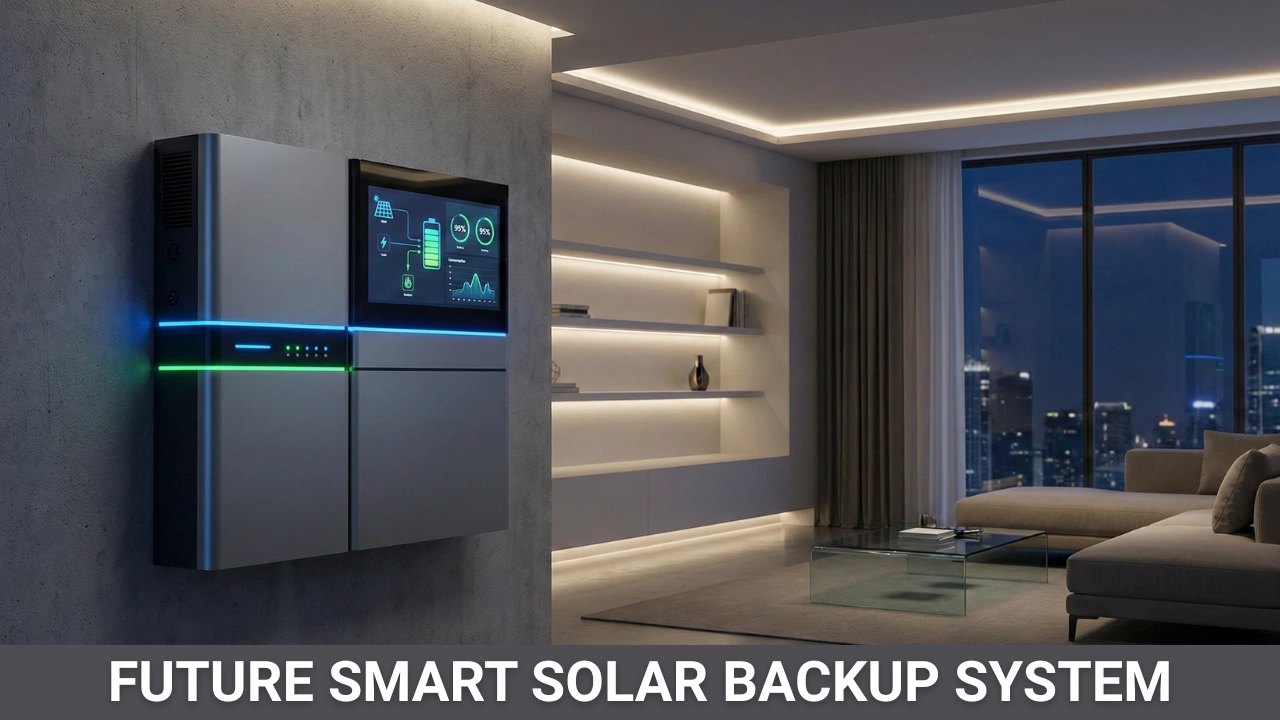
The solar backup industry is changing. Principal trends:
Battery prices are falling. Recent cost projections from the U.S. National Renewable Energy Laboratory show that battery storage costs have declined significantly over the past decade and are expected to continue to drop, helping make solar plus storage more affordable.
The hybrid inverters of the future are advancing. Recent workshops and research by the National Renewable Energy Laboratory note that PV inverter reliability, including advanced inverter technologies, plays a large role in overall system performance and impacts how systems handle rapid changes in load and grid conditions.
Standardization is in development. Better plug-and-play compatibility between batteries, panels, and inverters makes installation easier and more robust.
Grid-support services are in the process of launching. Some utilities now pay you to let your battery help maintain grid stability during peak hours. This strengthens the financial benefits of home backup.
Housing solutions for the apartment are being developed. Companies are testing shared battery hubs and rooftop systems for multiple units to address the issue of apartment space.
The direction is clear: solar power backup at home is now the norm rather than the only option for ensuring home resilience.
FAQ – Solar Backup Power for Homes
Q1. Can a solar generator power an entire house during an outage?
A solar generator can power essential appliances such as refrigerators, lights, medical devices, and internet equipment, but most portable systems cannot run an entire home unless combined with large battery storage and a hybrid inverter.
Q2. How long can a solar battery run essential appliances?
Runtime depends on battery capacity and household load. A typical 10 kWh battery can power essential circuits such as refrigeration, lighting, and communication equipment for 12–24 hours under moderate use.
Q3. Do solar panels work during a blackout?
Standard grid-tied solar systems shut down during outages for safety reasons. Solar panels can continue working only if the system includes battery storage and an inverter designed for backup operation.
Q4. Is a solar generator safer than a gas generator?
Yes. Solar generators do not produce carbon monoxide, operate silently, and can be used safely indoors, making them a safer option for home emergency backup than fuel-powered generators.
Conclusion: Preparedness is Practical, Not Paranoid
Power outages can occur unexpectedly, even in regions with generally reliable service (U.S. Energy Information Administration). When it does, you’ll need lighting, communication, refrigeration, and (if necessary) medical equipment in place.
Utilizing a solar generator for home backup enables this. Whether you opt for an affordable portable system at $2,000 or a $40,000-plus hybrid system, the aim will be the same: greater independence from grid interruptions.
The most important thing is to match the solution you choose to your needs. Renters and apartment residents start by using solar-powered portable generators. Single-family homeowners in areas with frequent outages benefit from permanent hybrid installations. Residents living in stable, sunny climates with predictable outage patterns can prepare accordingly.
It’s not necessary to have an ideal backup power source. You require adequate backup power to keep you secure, connected, and functioning during the outages you’re bound to encounter. This guide will help you make the best decision for your home, your family, and your peace of mind.
The technology is working. The economics are working. The real issue is not whether solar power is a good idea, but how best to design your home system.
If you’re also interested in how everyday technology is evolving, our overview of “modern solar gadgets for everyday life” explains how solar devices are becoming part of daily routines beyond emergency use.
“This guide is based on independent research and publicly available technical documentation. It is intended for educational purposes only and not a substitute for professional installation advice.”
“Sources referenced include the U.S. Energy Information Administration, U.S. Department of Energy, National Renewable Energy Laboratory (NREL), IRS, and Clean Energy Group.”
About the Author

SolarGizmoGuide is an independent solar research and publishing platform focused on practical, real-world solar solutions for urban homes and apartments. Our editorial team analyzes solar gadgets, mounting systems, backup power systems, and portable solar technology to help readers make informed investment decisions.
All content is based on independent research, manufacturer technical documentation, and publicly available performance data. Articles are reviewed and updated periodically to reflect current installation standards, safety considerations, and evolving solar technology.